Wednesday, September 14, 2011

The Flush

For the past couple months, I've been having an ear problem. Off and on, for a couple days at a time, my ear just starts pounding, some sort of mystery liquid just floats around up there driving me crazy and won't come out, and I catch myself flexing my jaw in public, making Quasimodo face at people, head tilted and mouth wide, while I'm talking to them. I don't like going to the doctor, especially here, since I know that nosocomial infections are bad in the states, but in a Filipino hospital, one can only imagine the germs that you might pick up in one of those musty hallways with thousands of babies screaming. I just figure I should take my chances with what I have, instead of monkeying around with trying to fix what's wrong and possibly getting a disease of higher severity. That was the plan until my earache came back in full force this week, making me wince whenever a light breeze would find its way into my ear canal. Reluctantly, I walked out to the little concrete waiting shed to standby for the next passing jeep. Fifteen minutes later, I boarded. An hour and a half and 50 pages of my latest book later, I was downtown Tacloban at the receptionist's desk asking for an appointment. It was a Tuesday, so I figured it wouldn't be a tall order. I got my number, gave them my phone number to ring me when ready, and waited 3 ½ hours for the appointment when I was called by the little receptionist. I hurried back to their office and gingerly set down in an examination chair while the doctor began by telling me how small my ear canal is, how all Americans seem to have really small ear canals. I didn't even try for logic.

The doctor then proceeded to mix up some fluids and then shoot them with a syringe into my ear. Now I've come to find out that ear flushing is a common practice for a lot of people, that it's almost routine for some. However, for me, this was a new experience and I found the soothing sensation of warm sterile cleansing fluids in my ears to be almost erotic. After 2 or 3 rinses, the doctor exclaimed, and grabbed forceps and after a painful tug, pulled out a relatively huge ball of pus and ear fungus that had been accumulating for some time. Now an ear nose and throat doctor sees a whole bunch of gross stuff, but this dime sized ball of crap really surprised her, probably helped to remind her of the little joys that got her into the business in the first place. Immediately following the flush, I was able to hear things that I haven't heard out of my left ear in some time. The doctor said I have a bacterial and fungal infection, that the fungal roots are pretty deep, and I can't swim for the next couple months, (at least I can't submerge my headJ). I now have this daily wash that I mix up and shoot up into my ear with a syringe. I should have noticed that it had gotten that bad, but I guess we just get used to mediocrity and mild discomfort when it does not present an overt encumbrance to our daily lives.

Now I was thinking that at this point, I could take this post in a number of directions, I could relate the ear problem to the current political situation and how we need to just realize the problem, make hard choices and go to a flat tax with a new deal sort of thing, talk about the need to push against becoming satisfied with sub-par, but I think that would be taking my ball of earwax and pus a little far. I'm just going to suggest that if anyone gets the chance this week to get your ears flushed, just make the trip, set the appointment, and get it done. You'll be glad you did, I guarantee it. Seriously, take off work, or school, use a sick day, or just play hookie, and go pay somebody to clean out your ears, and let me know how it goes.

Monday, September 12, 2011

Flag Ceremony, Babatngon

As things here in the Philippines draw to a close, I am increasingly cognizant of the little things that have become commonplace that I should probably try and explain while they're still fresh. One of those things is the flag ceremony. A weekly, even daily activity that is practiced by each and every one of the 1400 municipalities here in the Philippines. Now some municipalities practice the event every workday, with passion and vigor, and sing a special song just for the municipality, and they talk about logistics like when people will get paid, if there's enough water, emergency situations, stuff like that. But this is Babatngon, and we do things a little differently here.

At the little municipal complex of Babatngon, a one-story columned building no longer than 75 meters, whichever local government employees who decide to come to work stand around in little clique-like clumps on Monday mornings between 7:45 and 8:00. Women all stand around talking in hushed whispers about the latest gossip, while men stand in other clumps of 4 or 5, smoking Fortune cigarettes and jovially laughing in unison at usually lurid stories of passionate encounters. As 8:00 a.m. draws near, some of the more responsible gossiping women start to steal glances towards the area of the flagpole but don't dare move and initiate the arduous process of walking 50 meters and standing in place for the 10-minute event.

At about 8:05, usually there are a couple of cops who walk by in their finest carrying a big stick with which they wrap on the big flag pole to get everyone to come out from hiding. They clang the flag pole for 30 seconds and then the sloth contest to get into single file lines facing the flag begins. This takes about another minute or 2, and then, once in line, women giggle as they clump up in the shady grass area because the sun is beating down on the concrete area where they're supposed to stand. At this point, there's always a couple women who go and talk to the others, and tell them to stand evenly in the lines on the concrete, and yes, they know the sun is there, and yes, they know it's hot, and yes, they explain the ceremony won't take long.

Once the policemen have stopped clanging, and the ladies are standing in line, and the men have stamped out their cheap cigarettes, we all stand quietly in line, looking forward at the flaking paint of the little municipal hall, the barred windows of the offices, and the Philippine flag waving, when a deafening sound comes from 2 huge speakers stolen from a Pearl Jam concert and they begin blaring out the national anthem. Now these speakers are a new development, and we used to all just sing in unison, acapella, and mumble half-heartedly through the song, but now, with the speakers, there is no need to sing, since you can't hear yourself anyways. After the national anthem is over, there is usually a short announcement from some lady I still can't remember the name of, when she lets us know why the Mayor isn't there again, and then the crowd disperses, the only sounds to be heard are wooden heels clicking the concrete parking lot and the lonely scratching voltage of the sub-woofers over at the municipal hall doors.

Although maddening, I'll miss the dysfunctional idiosyncrasies of our brief weekly flag ceremony, here in Babatngon, Leyte, Philippines.

Thursday, September 1, 2011

One Man’s Trash…

Playing a little ball with the neighbors


Last week, I got a wild hair to start the process of cleaning the place up to prepare for my departure from here in 45 days or so. My family would attest to the fact that I'm not a very tidy person, so whenever I feel the initiative to clean, I figure I better run with it and make hay while the sun shines. The first and easiest part of the process of taking the place apart to get it ready for my absence is to start taking stuff off the walls. I've mentioned before that my mother is both a gifted an a prolific photographer, and during the course of the past 2 years, Selena and I have taken all of the pictures of home we've been sent and taped them all together in big collages all over the walls. It's really nice to see those familiar sites from home all over the walls whenever we're sitting around, the green green grass of home, you might say.


Unfortunately, a lot of the pictures have faded as a result of all the sun and humid Filipino air in our house. I took down the collages, one by one, and kept the best of the pictures, the least faded, and reluctantly trashed the rest. After dealing with the collages, I went through a couple stacks of papers, teaching notes from the Filipino Science class I taught, little notes from students, papers from the Municcipal Office, letters to various politicians here, notes from meetings from the fisherfolks, flash cards for language learning, receipts for coffee and rolls, snorkels, nylon and buoys, a pretty good paper anthology of my work here over the past couple years. I threw most of it away, charging my memory to retain most of those activities since it doesn't make much sense to pack pounds of little papers out all the way back to Virginia. It's always hard for me to get rid of that kind of stuff, although I'd probably never look at it again, it's nice to know it's all there just in case. After going through the papers, my itch to clean was all used up, and I went out to play basketball and swim at the waterfall.

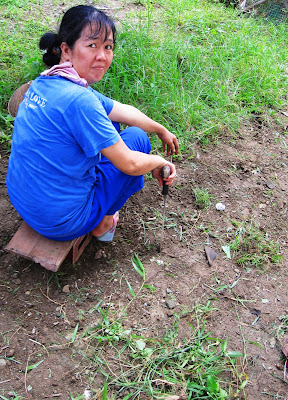
Mana Bea, the mother of our host family, doesn't take kindly to her picture being taken.


Later in the evening, I came back to the house, and saw the mother of the family downstairs with those collages in her hands, the faded pictures of family and familiar places. The sound of the door clapping behind me startled her and she looked over at me from the collage that she was holding up in front of her like a newspaper. "Why you throw these?! We need remembrances."


It is always irritating when she gets something out of our trash, but she was earnest in wanting to keep all of those faded pictures so that they would have something to remember us by. It's not really even us though. She was keeping pictures of my uncles and aunts, cousins and friends whom she will never know, all faded, and pictures of trees and flowers that didn't have anything to do with us. It was more like she was keeping the proof that people had lived and laughed with them, people from a distant place, people who looked different and talked different. In my haste to wrap things up here, I sometimes forget the cultural divide that we have bridged and the importance of a foreign presence to people who don't have much else to be excited about. I'd like to think that we'll be missed for us, for what we have done, but more likely, I think we'll be missed for the sense of specialness that our presence gave to others here, the pride of their town being picked to have people come and live for a while, leaving nothing but footprints, taking nothing but memories.

This is Mano Ted, the family father and little Nobi, the youngest of their 6 kids, helping to fill flower pots.

Late that evening, the trash fire consumed all of those little notes, receipts for rolls and snorkels, letters to politicians, flames molded them all back into ashen newness. And lots and lots of faded pictures went into a cardboard box, evidence of these two years.


This old fellow reads incessantly at the little waiting shed at the end of our lane, and silently watches the days come and go, shoes repeatedly repaired, and beard bound with rubber band. I really like him and his satisfied way of being. Just being.

Saturday, August 27, 2011

100 Million People in New Mexico

If you were to take all of the 7000 islands of the Philippines and cram them together, the combined land area would resemble that of Kansas or New Mexico. It's not a big country. However, recent census figures estimate the population to be around 95 million people, give or take a few million due to all of the people squatting on government land and without birth records. Upon arriving here as a volunteer, I had two nagging questions concerning these figures.

1) How in the world do you cram that many people into that small of an area and expect them to be able to live?

2) If Filipinos can coexist with that sort of population density, then we have a lot of potential for growth in the states where the population density is much lower, right?

When sitting watching the fishermen earlier make raw fish with vinegar (Kinilaw) for lunch, and nodding off with the fresh monsoon winds that were whipping against the floating guardhouse, I decided that now, at this point in my service, I have answers for these two questions.

Question 1: Filipinos are very social and are able to be happy in the tightest of conditions (Refer to Post #51 What Really Matters.) Natural resources, although greatly denuded here, are utilized to their entirety. Every single animal that lives here is eaten. There aren't any taboo animals, well, except for puffer fish, I can't figure that one out. Snakes, rodents, dogs, water buffalo, pigs, monkeys, lizards, and salamanders are all eaten, along with birds, poultry, fish, sharks, rays, squid, seaweed and a lot of other stuff. I think of the fat, healthy looking herbivorous groundhogs at home that people shoot and just let lay due to some sort of choosy taboo we have about eating rodent-looking animals. When a ray is caught in the ocean in the states, it is often thrown back even if it is dead, because we're just really choosy. One time, early in service, the family Dog of a fellow volunteer's host family got Tetanus and died. Within a day, a neighbor had come and carried it away to cook for supper for his family. No joke. People here eat fish heads, pig face (Sisig), pig and poultry feet, barnacles, all sorts of filter-feeding shellfish. Whatever isn't eaten, is given to the livestock pigs, and then in turn, those pigs are also eaten when they are of roasting size. Small filter fish are eaten raw and dried. People just don't have qualms about it. Ofcourse there are problems of over-harvesting of timber and fish here, along with pollution and soil conservation, but those are education-related issues it seems. For the food though, there is just very little waste, nutrients all enter and exit the cycle over and over again and this sustains a population that is incredibly too high for the land area it occupies. There is a general lack of money here, and lots of malnutrition, (too much rice, lack of protein, stuff like that). This high resource use is very different, I feel, from the situation in the America where there is incredible waste of food resources. We're really really picky, and I didn't really see that until I came here. An old lady whom we lived with for a couple months at the beginning of our service here in Babatngon pulled me aside one evening, her ancient withered hand yanking at the sleeve of my shirt, and huge false teeth gleaming white "You know, us Filipinos always say that we would never go hungry if we moved to America. We would just eat all the fish heads that you people throw away."

Question 2: No, Americans don't have a culture that would support this level of population density. We like our space, our autonomy too much, and there would be an all-out war if we attempted to squeeze 100 milllion people into New Mexico. It just wouldn't work. Filipinos though, thrive on closeness, on what I call crammed quarters. That's why you can get 45 fairly happy people into a the back of a pickup truck here without so much as a complaint. At a Peace Corps conference, my counterpart was placed in a big, nice hotel room with only one other person and she nearly freaked out, said that there were spirits in the room, and vowed to never stay in such a large area nearly alone again. Similarly, the family of 8 downstairs prefers to all sleep together in one little room instead of spreading out throughout the house like they could. It's just a really different mentality here. Closeness is comforting, space makes for intense loneliness. Most people agree that the population density here in the Philippines is way too high, but it continues to work for the most part because, although unsustainable in terms of jobs or livelihood, the culture makes it possible.

Monday, August 22, 2011

Abstract: New Methodology for Eradication of Closet Room Dilemmas in Developing Nation, Barlow P.H. et. al.


In addition to leaving the heat, the aggravating rainstorms that get your clean laundry wet, the periodic blackouts, and sketchy public transportation, in about 8 weeks I'll be leaving a non-functional toilet behind that has plagued me for 2 years now. Indoor plumbing is less than dependable here in the Philippines, and about 80 percent of the public establishments still have toilets that you have to flush with a bucket of water, not with a handy little lever as we are accustomed to in the developed world. Whether you are in a hospital or a coffee shop, restrooms will have A) no toilet paper, B) a bucket of water and C) a big dipper to wash off your you-know-what when you get done with you-know-what.


Anyways, I would love to be blessed with that situation at home, but instead, we have a toilet that cannot even be flushed with a bucket. That's right, every single trip to the bathroom, you have to plunge everything away. I don't understand it, it's like they put a 1-inch pipe on the bottom of a toilet, like anything would go down that, and then, to top it off, they encased all of the pipes in concrete so that even if you wanted to fix something, there is little chance that you ever could. I'm serious, not embellishing this situation one single bit.


I broke the plunger about 5 months ago. Since then, not being able to plunge directly with the jagged broken plastic end of the apparatus, I have been using a wooden spoon over the top, to dissipate the force of the broken handle and make it easier to use, since I can never remember to just buy another plunger at the market, what with all the people looking at me and asking me, "Sir, do you want Bananas?" or "Sir, do you want fresh fish?" or, "Where are you going, Sir?" or "American!" or "Hey, Joe!" I usually find that no matter how long, the market experience has taken long enough, and I hurry back to Bag End where the hobbits hide away waiting for another adventure.


Moving on, I remembered to buy a plunger today. It's a locally made plunger, from tire rubber and with a wooden handle. It cost me 70 pesos, (I bargained it down from 75.) It's a good plunger. Now, instead of broad, decisive blows to the toilet bowl, I have been utilizing the rescue breathing ratio of 5 soft blows and then I step away for 3 seconds and listen for breathing. It's been working so far and I think that I might have a system now to last me for my final 8 weeks of dealing with my irritable toilet.


Friday, August 19, 2011

Fish!!

If you have followed this blog in the past, you will have seen several posts about the Integrated Aquaculture Project here that has occupied most of my working time for the past year or so. It's a project where we are growing seaweeds in concert with Bangus Fish, the Philippine national fish, to generate the livelihood for 35 families in the coastal area here as well as improve understanding and enforcement of local environmental protection laws for a marine protected area. Seaweeds filter water; they utilize nutrients like nitrogen and phosphorus to grow carrageenan, an important cash crop the world over. It's known in the environmental field as a bio filter, one of the things that yield a double return, cleaning the environment while producing a useful material. Carrageenan, as I've mentioned here before, is used in laboratory supplies, as well as jelly, Jell-O, toothpaste and many other vitally important products. We can sell seaweed at a local factory, where they pay a base price for the dried product, the profit which is then split up and given back to association members for working every day to clean and harvest the seaweeds. Thus far, the fishermen have made around 8000 pesos ($175) from the seaweed harvests and the stuff is still growing strong. The seaweed is a new idea to most of the members who consider themselves fishermen first and foremost, and farmers of this slippery, slimy stuff second. Despite their reservations, the men have gotten into the habit of going to the ocean every day and shaking algae and dirt off of the seaweed, trimming it, and drying the harvested pieces. At times it has been hard, keeping these men interested in a project with seaweed that they never really asked for. At the outset of this project, I promised the men that I would find them funding for a fishcage project, (something more of the cultural norm in these parts, a much more tangible project) if they would be willing to try growing seaweeds, a lower return, more environmentally-friendly crop. They obliged and ever since, we have been working the seaweeds, waiting with baited breath for the arrival of their hallowed fish, the 'real' livelihood project.


This past week, the project finally came together in its entirety. After lots of heated texts and rousing speeches about fortitude and project goals by the resident persistent American (me), the municipal dump truck showed up Wednesday with hundreds of bags filled with little fish fry from the local nursery. In all, we received 5000 little Bangus fingerlings and now the 35 fisherfolk association members are beneficiaries of a 'legitimate' livelihood project, raising fish. They are changed men, what can I say. There are certain cultural litmus tests that have to be passed for the members to feel real pride in this project, I've found. One test is the association boat. For two months we borrowed boats, used private boats, even paddled out to the seaweed project to work, but once we bought an association boat, members were changed. I found that here, to be a bonafide association, you have to have your own boat. That makes you legit. Period. I don't know how to explain it, but there is a palpable change in the men since we have gotten an association boat, it seems to give the group a common, tangible bond that they didn't have before. The fish cage is the same. The members would be willing to work on anything that brings profit, but when they are raising fish, a crop they know and others recognize, the project has a certain credibility that wasn't there before.

Earlier today, Selena and I went out to the project site with a Peace Corps supervisor, Philippine government workers, and association members and sat with association officers while they fed the squirming, writhing fish, and they were able to talk as authorities about their project, the feeds, how they are doing, the condition of the nets. If nothing else happens, if the project were to die tomorrow, the fish were to escape into the surrounding ocean, if seaweed were to suddenly die, I can be sure that the members of the fisherfolks organization have pride, and I did as much as I could to help them achieve their potential. As this experience winds down, and I pack to go home, taking what memories I can fit onto a hard drive and in my mind, leaving the children, dogs, neighbors and friends I have met, it is a sound consolation to know that I've done what I could to help.

What really matters?


A good friend recently lent me the book "The Art of Happiness," a series of interviews and excerpts from speeches by the Dalai Lama. I haven't finished it yet, not even a half an inch through it, but something that I found meaningful for me in the first hundred pages was a very clear distinction that The Dalai Lama makes between pleasure and happiness. Pleasure, he articulates, comes from attainment of the perfect body, possessions, and soul mates of our dreams, the gratifying albeit fleeting satisfaction that we get them all. Happiness is the lasting satisfaction that comes from a cultivated compassion for every other human being, the satisfaction that comes from finding intimacy in every encounter, and every relationship we may find ourselves in. Intimacy of course, as is defined in the book, is whenever any two beings come into bodily contact, not our western view that intimacy must be an erotic encounter between lovers. While reading this explanation for the distinction between pleasure and happiness, I began to think about the wide chasm of difference between my native culture and the one that I have come to embrace here. Anyone who has the chance to spend a couple weeks living among Filipino people would most likely attest to the fact that people here, although living lives devoid of the 'pleasure' we have in America, are much 'happier' than persons in our corner of the world. Filipinos are much more tactile people, always touching your leg or rubbing your stomach or arm while they talk to you. Oftentimes, I'll be sitting with a group of middle-aged men, drinking tuba (coconut wine) and eating little bits of squid and raw fish, and one of the guys will turn to me and start talking about something or other, whether I understand him or not, and he'll put his hand on my thigh the whole time while he tells me some local joke or story, and laughs a hearty laugh. Now just think about what would happen if that kind of intimacy occurred in the states, if some guy at a bar put his hand on another guy's thigh while he joked with him and talked about a football game. It's been one of the weird things to get used to here, and although I've been uncomfortable at times, I see this affection, this tactile nature, as one of the things that makes these people so happy despite their need for so many material possessions that we take for granted. Of course it's not just their aptitude for touching each other's thighs that make Filipinos happy, but this is just one facet of the culture of unconditional affection, compassion, for each other, that I've come to appreciate. This culture of affection can be infuriating when you wish to hold people accountable for wrongdoing, when you wish to confront someone who has gone against the grain, stolen goods, not done their duty cleaning seaweed, stolen your precious tomatoes from Virginia, but at the same time, this nurturing, amiable culture creates a higher level of happiness among people. There are definitely many things that this culture could learn from ours, indoor plumbing, road right-of-way laws, traffic enforcement, basic sanitation, natural resource management, but I think many of these pale in comparison to what we stand to learn from the culture here: Happiness.