Saturday, January 8, 2011

Bookshelves and Organizing


I started the week with work at the Public High School, talking to the principal and other teachers about the need for bookshelves, how we need a place to put extra books since we just received a generous shipment of used books from Virginia and Pennsylvania, and we need new, durable bookshelves in which to house the novels and picture books. Throughout a couple of agonizing conversations, I convinced the others of the need for new bookshelves, and my need for a companion to go to the city and help me buy lumber on Tuesday.


Tuesday morning, I met my companion, friendly Mr. Cadano, a thirty-something guy with a huge smile, bowl hair cut and big gut, at the school waiting shed, and caught a jeep to town. We got there after an hour-long bumpy ride and we immediately met with a man at the front who took us to look at available hardwood boards, approximately 1 inch by ten inches wide, and 12 feet long. Sounds simple, but you'd be surprised. First of all, hardwood is taboo here. Since a moratorium was imposed in the 1970s on cutting any trees but those designated by permitted, licensed personnel, on any land, people have been afraid to buy, sell, even travel with quality lumber. Illegal logging is rampant, but it either goes on at night, or under supervision by people paid to not care. So anyways, it was weird to be buying this lumber first of all, but secondly, to find transportation back to my place in the countryside was going to be hard seeing as how everybody is afraid to transport lumber. I ordered 6 – 12 foot boards, enough to make 4 bookshelves for right underneath the chalkboard in the school library. I ordered, and then left Mr. Cadano with the clerk while I went out to see that the boards they chose were the right ones, and that they put them somewhere so that no one would steal the lumber before we came back. Seeing that everything was secure, I returned inside, there to wait at the receiving section, (an area 5 feet away from the ordering section (this is a small place)) where I would be awaiting my change, along with lumber, screws, metal brackets, and sandpaper. After about 30 minutes, the receiving clerk came back with a little box of ¾ inch screws, and another box of 1 ¼ inch screws. Now the clerk told me that if I bought my 100 screws in singles, the screws would cost 2 pesos apiece (4 cents), but if I bought them in 'gross' I would receive 144 screws for 95 pesos, a savings of about 2 bucks, so naturally I said yes. Well, my 'gross' purchase entailed a stockboy counting out all 144 screws for the next 5 minutes. When complete, he gave them to the receiving clerk, who proceeded to double check, counting out 2 boxes, 144 screws each. Around 35 screws into her 288 count, the receiving clerk received a phone call from her sister, talked about her husband for 10 minutes, then hung up. However, after the phone call and supposed urgent news, she had lost count, so she emptied the box again, and started counting. About 100 screws in, she found a flat head screw, the wrong type since I had ordered Phillips screws, so she had to find the correct box to return the screw to. The screw saga continues, but I'll just let it go and say it was mind numbing, putting it mildly.


After receiving my screws, sandpaper, receipt, and brackets, I went back outside where my lumber was laying, and Mr. Cadano exclaimed that something must be wrong because there were six boards.


"Well, that's the amount I ordered" I said.


Mr. Cadano: "I told the lady to just give us 5 pieces because it costs over 600 pesos ($12) apiece!"


Me: "Yes, but I told you we need 70 feet of wood, and if we only have 5 pieces, that is not enough wood, that is 10 feet short."


Mr. Cadano: "But 1 board is over 600 pesos!"


Me: "You wait here, I will go get one more piece of wood to build the bookshelves properly."


Mr. Cadano: "Agi!(Ouch!)"


Thus began another 30 minutes, from explaining that yes, I wanted 1 more piece of the same type of wood to the lady at the front desk, to ordering, to waiting again for the receiving section (just 5 feet away from the ordering desk) to answer phone calls, write down multiple receipts, and give me change.


I finally got all of the stuff, convinced a jeepney driver to take me and the wood back to Babatngon after a lot of haggling and 300 pesos, and had some neighbors help me haul it down our muddy lane by hand in the rain. I have spent the last few days building the 4 bookshelves, things have gone well, and they look pretty good, considering I have no hand tools, and am just using my new little hand crank drill to make holes for the infamous screws. I have never had to exercise so much patience for 6 pieces of wood, and I hope to never have to again. All this said, it has been so nice to smell fresh sawdust and do some manual labor for a change. The wood I have had to use is Lawaan wood, a reddish wood the shade of cherry with the grain of birch. It smells like Red Oak and sands like Mahogany. The experience of making the shelves has provided me with a great outlet for stress as well as the opportunity to meet several neighbors as I ask around to borrow a square from one person, a hand plane from another, a screw driver from another, and a saw from someone else. Various members of the family downstairs poke their heads up from time to time to check my progress, offer comments like, "Your saw not sharp" or "You now a carpenter?!"

Tuesday, December 21, 2010

Lunar Landing


This past month, I haven't updated the blog much, but there's been plenty going on. The first couple weeks of November, we continued teaching classes at the Catholic and public high schools. One of the most meaningful moments I got while teaching this month was introducing my beaming class of 58 1st year high schoolers to the fact that humans landed on the moon. This doesn't sound like a groundbreaking task I'm sure, but I found in really humbling to be endowed with the responsibility of conveying the importance of the event. I started with the size of the Earth and the Moon, and the distance traveled by the spaceship (238,000 miles) put in terms of the distance to the closest city, Tacloban, which is 24 miles away from here. We talked about the mass of the two floating rocks, why gravity is so much less on the moon. One day I tried, with two big balls of paper and an old globe from the library, to depict the moon's revolution around earth, the monthly phases. One night, I asked students to sit outside and just look at the moon, record the phase, and think about what they saw. Then, on one of the final days of the moon talk, I told the students about Neil Armstrong, and how he walked out of the ship, and uttered the famous line 'One small step for man, one giant leap for mankind..' I got students to stand up, come to the front, and one by one, I surrounded them with my arms, made a big "sssshhhhh" sound (an aweful imitation of what I imagine a spaceship door to sound like) while I spread my arms, the students then took one step, and slowly read from the chalkboard the unforgettable saying.


I honestly don't know if the students got it, if they understood what Neil Armstrong said, or why we wanted to fly up there in the first place. The students are coming from a background where it is hard for them to imagine any type of innovation like that. Without the historic context of Sputnik, or JFK, or the race to be the first, I haven't much Idea of how important they perceive the event to be. I do know, however, that I finally got it. It's one of those things that I've read and heard and seen, but only now do I get a feeling for what a huge time that was for everyone who saw it happen.


It gave me so much pride to tell these students that man is capable of such a feat, and that even the sky isn't the limit anymore. I have a pretty good idea now of the obstacles, financial, social, psychological, that face the studetns. It gets really discouraging sometimes to think about the lack of resources that were, are, and will be here for them, and what that means for these students' futures. But I was reminded while making spaceship sounds and lumbering around as if in a spacesuit in front of 58 Filipino students that really anything is possible.

Sunday, October 31, 2010


This week, I was able to participate in the 8th annual exploration of Calbiga Cave in Western Samar, with 10 other cavers and 4 porters who live near the cave. We spent the better part of 3 days hiking in and out, and exploring the interior of the cave, and two nights camping in the cave.


There are many caves that are longer in distance than Calbiga, but it ranks first in Asia for sheer volume, as most of the rooms are so large that you cannot see one side from the other, and at most places in the cave, even the brightest LED cannot illuminate the ceiling, which in some places, is over 100 meters high. The locals here in the Philippines do not venture inside caves, as they are seen as places where demons and 'fairies' reside, so therefore, many caves are still not mapped here, and the ecosystems, largely undisturbed are relatively pristine, with huge cave crickets with adapted long antennae and reduced eyes, blind cave crabs, blind fish endemic to this one island in the Philippines, as well as cave snakes, huge spiders, tarantulas, and, ofcourse, cave sparrows and millions, (literally) of bats of all kinds.


The first day, we got inside the cave at around 1:30 after hiking about a kilometer in off of a dirt path where we rode to the drop off. We hiked about a kilometer down into the belly of the cave to the campsite where we laid out tarps, tents, cots, and hammocks for our first night inside. We immediately saw a snake we estimated to be 7 feet long on the campsite where we would be spending the night, gingerly chased it off to another area, and hoped it wouldn't be returning. The snake was identified by our guide as a Philippine Cobra, a venemous, but rather subdued snake. After a few hours ciesta, we got up, and walked into the cave, over thousands of boulders trekking to the back of the cave, past walls of flowstone, and past ruins of harvested calcite stalagmite towers taken by koreans before protected status came to Calbiga in the '90s. (We were told that Koreans paid 6 pesos per kilo of calcite harvested from the cave and would use raw calcite for industrial processing, or would just sell stalagtites for souvenirs or whatever) Anyways, that's when my shoes fell apart. I'm not embellishing, they literally fell apart, after months of use and rebonding with superglue and shoe goo, they just fell apart, first the rubber soles fell off, then the fabric bottoms of my shoes, so then I was just walking in sock feet over a boulderfield of jagged limestone. Now you might say "Wow, that sounds awful", and basically, you would be dead on, it sucked. One of the porters, a guy about 20 years old who was carrying our rubbish and urine (we were packing everything out, as any nutrients from foodscraps, trash, or our bodies could disrupt this fragile ecosystem) gave me his rubber boots, didn't even think twice, and although I tried to refuse, since it was my lack of good judgement that brought badly suited shoes, he gave me his shoes. He was left carrying about 40 kilos of weight on his back, walking through the cave on boulders in bare feet. He wouldn't take his shoes back, so although my feet were about two sizes too big, I squeezed my feet into the rubber boots and walked on. We got back to camp around 11:30 and all went to sleep, hoping that the snake wouldn't return and the crickets wouldn't get too rowdy.


Day two, we rose, took down camp, and ventured on to our next camp site, about 2 kilometers away. The site was in the wet area of the cave, where the cave is still 'alive' since water is still flowing, leaving the calcium deposits which basically build the cave. It is estimated that the process of stalagtites growing by means of calcite deposits, or gypsum, or whatever, takes, on average 100 years to produce 1 centimeter of growth. We saw some stalagtites in the cave that were over 10 meters tall, do the math and thats a 100,000 year old work of art. It's really something to see such incredible pieces of nature that have emerged over millenia, and just think about all of the time and history and birth and death and growth and regrowth that they have supported, the beauty that has emerged out of absolute darkness over years and years of flowing water, drip by drip, molecule by molecule. We hooked up ropes and hooked in to descend a short portion of vertical climbing, but for the most part, the going was much easier than the first night, with much less bouldering to do, and much more walking around forests of columns and stalagmites.


In the early afternoon, we arrived at the lagoon where we would be camping for the night, but found that the typhoon which came through here last week had made it into something more like a lake, and we would not be able to camp where we normally would. Our porters swam the lake and went outside to find bamboo to construct a raft that we could use to portage perishables and cameras across the water while we swam. The raft was a success, and at about 5, we had arrived at the exit of the cave, larger than the entrance, about 200 meters across, and about 120 meters tall, with a towering jungle falling into sight, it was really someting. At this point we were surrounded by the sound of bats preparing to exit the cave for the night and we found a small overhang in a pocket of the cave where we could set up camp for the night without the threat of getting covered in a layer of gwano by morning. We then witnessed the exit of hundreds of thousands of bats around 6:30 p.m. and prepared for our night exploration of the live cave.


We spent the night going to the lower portion of the cave, where there were many pools lined with calcite, many tarantulas, much more fauna overall, and cool waterfalls where we were able to swim a bit. Unfortunately, I didn't get any pictures of this part of the trip since we wer fully submerged during a small sump where I was afraid my camera would get wet, but take my word for it, it was a great experience.

Sunday morning, after a chilly night and not much sleep, we took down camp, and climbed through the jungle for around 5 kilometers to a spring where we got fairly clean, and waited to rendezvous with our transportation. It was great to be going back, and since I didn't have much money to give him, I handed my favorite Carhart working jeans that had seen me through the trip to the porter who had given me his shoes without hesitation. He looked at me as I held them out, and I explained in broken Waray that since he saved my feet, I wanted him to have my pants. He didn't thank me verbally, but took the jeans, looked me straight in the eye, and went to washing the cave dirt out of them in the stream while we relaxed in the cool water nearby. He scrubbed and scrubbed, and by the time he was done with them, they looked as good as new.


I have been to many caves in Virginia and West Virginia, where the limestone bedrock of the Aleghany Plateau gives way to some of the best caving in the world, but one huge difference is that the ecosystems of the eastern United States Caves have, for the most part, died. Lots of the terrestrial life has died or been reduced dramatically, and right now White Nose Syndrome, a non-native fungus probably spread by well-meaning humans just visiting caves, is systematically killing the majority of colonies of eastern bats. I have never seen as many snakes and critters in Virginia caves as I did in this one cave in Samar. I don't think we are more careless with our caves in the US, it's just that we like to see everything, to 'look' at everything, to 'experience' everything, and it never seemed so bad until I got to see the ecosystem as it used to be, fully functioning, without the endemic species having been extirpated through 'exploration' or 'study'. It reminds me of Thoreau's saying that 'Man is rich in proportion to that which he can let alone.' I don't think he was referring to caves in Samar when he said this, but his statement definately fits.

One part of the trip I keep thinking about now is when I was down in the bottom of the cave on the second night with about 5 of the others and one porter, and we all were washing in the waterfall coming from one of the huge calcite-rimmed pools. It was like a paradise, cool, refreshing, clean water, and just the sound of our voices and the rush of water. Everyone of us was washing, shirts off, heads submerged, as one of the porters sat and watched. Concerned that he felt ashamed to wash in the same water, to have fun with all of us, I asked the man to come and bathe with us "Pwede makarigo ka liwat?", he looked at me and laughed and said "Hilo it tubig"(Poison water).


Friday, October 22, 2010

GIS Training, Bacolod City


This week, I spent my time in Bacolod City, in Negros, Occidental. It is a beautiful city, very modern, with lots of culture and pride. I was working with three Australian volunteers from two different Australian organizations, and with two other Peace Corps Volunteers, one of which is a Peace Corps Response volunteer who was in charge of setting up a GIS training project.

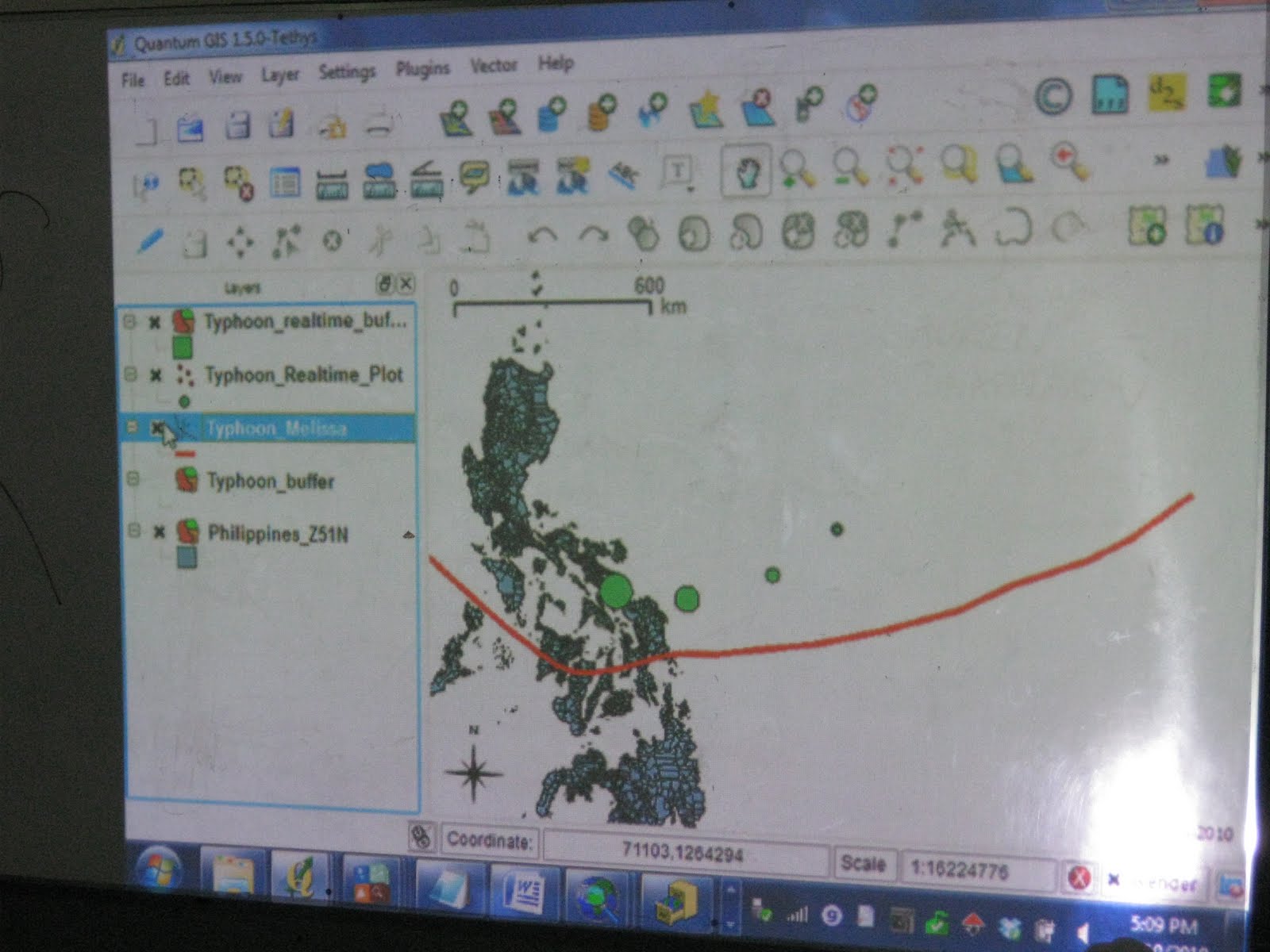
The objective of the whole week was to work with Provincial government Disaster Management Personnel to train in the use of GPS and GIS tools to create spatial data for modeling and reference during emergencies like typhoons, floods, earquakes, landslides, and volcanoes here. If you are familiar with GIS, you will understand how the creation of spatial data on demographics, structures, dwellings, roads, rivers and the like can be used to not only respond to disasters, but predict effected parties, steer land use planning in disaster-vulnerable areas, and do a multitude of other functions.


Our class consisted of about 40 Provicial engineers, employees, and IT staff who would be in charge of gathering required information to be consolidated into GIS databases and would also be tasked with attaining new GPS'ed information on existing features of areas, population data, all sorts of stuff. Although the training was really technical, and we packed a huge amount of information into one week, teaching everything from satellite triangulation, to explaining Latitude and Longitude, to going into digitizing information and creating modeling scenarios for natural disasters, the participants hung on and got a lot out of it. The ultimate goal, to teach people the need for this technology, and to get them interested, was superceded. At the end of the 5 long days of training, people who were learning how to right click on Monday morning, were asking how they could get recent Raster files for their provinces and how they could simultaneously project multiple files into WGS 84/Zone 51. In other words, they came a long way in just 5 days.


We were fortunate that while we were here for the training, Bacolod was also celebrating the Masskara Festival, a famous mardi-gras type of street fiesta. The festival is full of ornate costumes, dancing, music, and lots of drinking.


Throughout the week, I was really impressed with 1) the participants showed a real investment in learning the material and a stamina for sitting through a full week of really tough stuff, and 2) Our Australian counterparts showed a level of professionalism that was really a breath of fresh air. It was an air of sophistication that I really haven't seen during Peace Corps trainings thus far. I've worked with Australians before on field crews where I could see clear differences in culture with Americans. I think the lack of perceived professionalism is due in part to Peace Corps' efforts at total integration and understanding of the local culture, and we could see the real value of a truly straightforward approach without the games, or the wavering deadlines, or really much 'emotional' stuff at all. Us Peace Corps volunteers were very soft with our communication, giving energizers at breaks and singing songs to break the tension, all of the suggestions we've been given by program staff, while the Australians were nice, but did not spend as much time 'making people comfortable', got right to the point, moved along at the necessary pace regardless of whether a few people were left behind, and ultimately, the Australians, I believe, were more successful in getting the information across to participants.
People seemed to respect the fact that the Australians were not as interested in being 'fluffy' and 'nice.' It just helped to show me that cultural integration and patience has a place, but sometimes that is not the most effective in achieving the desired result.

Thursday, September 23, 2010

September 2010


The last couple weeks, like all weeks here, have held many new experiences. I'm always learning things here, about the Philippines, about cultures, and about myself. Last week, September 12-17, I spent my time in Babatngon, attending training that we set up for our fisherfolks in the morning, teaching in the afternoons, and watching beauty pageants and birthday parties in the evening.


DTI, the Department of Trade and Industry, came out, at the request of my office, and spent 2 days teaching basic bookkeeping and accounting to the fisherfolks that I am working to organize. The training was great, expecially because it was done by native speakers, who understand the culture of the area better than me. The success of the training reminded me that such services are available, and trainers are willing to come out, and that the job of volunteers like me sometimes might be to just get people communicating, so that trainers know where the needs are, and so that those in need know the proper channels to avail of services. I am finding that often times the NGOs and grants and government services are there, there is just little to no accessibility for those services. Although it is not as 'sexy' for me to be networking and talking as it would if I were out giving money and building houses, the work is probably much more sustainable in the long run. Afterall, I'm here for 2 years, but these government agencies and support services will be here much longer, so if people know where to go when they're on their own, it's going to help a lot.


This week, I went to Zamboanguita, Negros. Since the airports are small with limited flights, I had to fly to Manila first, and then back down to Dumaguete City, Negros, instead of taking just one direct flight here. It was good though, to get to walk around in the city, go shopping, feel extravagant. Zamboanguita is an incredibly nice place, with world-class coral reefs within walking distance, very nice, welcoming people, and lawns, huge mango trees, and public areas, which I have come to appreciate most of all. (Public land makes America Great - Another blog, another day) It is really interesting to be so close to Leyte, and the culture be so different. The language is different, the way that people meet and greet is different, education seems to be much different, it's like if Norfolk Virginia, and Lexington, Virginia spoke different languages, had different school systems, had vastly different ways of welcoming people into their homes. It's really something to think how 50 miles of ocean can so effectively isolate cultures from one another. The family with whom I stayed in Zamboanguita was really something, making food for me, welcoming me in every way, and really seemed to be honest, unconditionally friendly people.


I have now returned to Manila, the taxis and the shopping and the loudness of it all. Unlike the United States, where poverty and extravagance are separated by distance or highways, here the two are side by side. Street children greet you asking for change in every part of town, people urinate on the sidewalks outside of casinos, and in front of the biggest malls in the world there are persons carrying their life's accumulations in trash bags. The livelihood here I'm sure is no less than it is in Leyte or on other islands, but everything here is cramped, and the poverty has nowhere to go. The poverty can't go and hide inside a nipa hut, or find a lean-to in the mangroves. The poverty here can't go to the ocean to wash the excrement and filth away. The poverty here stares you in the face and takes your breath away. It's unnerving to have to mentally justify the economic chasm between you and it every time you brush past or shift your gaze. The only times I have seen this type of poverty have been in big cities in the United States, mornings when people are still sleeping on benches or stoops, and the biggest difference is, that those people I have seen have been alone, an aging woman or man, smelling musty or of alcohol. When they're alone, it is always easier to say that that person must have screwed up at some point, must have fallen into alcoholism or drugs or gambling. Whether or not its true, it makes it easier to walk by.

But here, when you see whole families, your mind can't even come up with a reason why the kids should have to suffer like that, and your mind goes blank, without a reason for why things are as they are. Poverty is horrible anywhere, and no one deserves it, but for kids to have to start out like that, to have never had a chance to get started, it's hard to see that.

It is definately good to be within reach of internet and starbucks and the central office for a little while, but it will wear off quick, and in a couple days, I will be happy to see Leyte again.
*View of the World Famous Apo Island from Zamboanguita, Negros

Saturday, August 21, 2010

Week 52, Pete in the Philippines


Yes, folks, that's right, week 52 come and gone, 1 year of this exciting, frustrating, educating, invigorating, excruciating, experience is over. The year has been tough, lots of ups and down, lots of new experiences, and like I have mentioned in previous posts, they have all been challenging in the most unexpected ways. What seemed like it would challenge me the most at first, like the new food and lack of variety that I have grown accustomed to, or the new transportation and lack of my car to take me wherever whenever, or the heat and humidity; these things have been a challenge, but they pale in comparison to the challenges faced by endless scenes of poverty, the tug that I get when I have to walk by street kid after street kid asking for change, the longing for family, familiar faces, and the sweet loam of the Shenandoah Valley, quiet walks on public land, Appalachian Mountains, traffic laws, and I'm sure they mirror the plethora of things missed by other volunteers and overseas relief workers in my situation.

There have been many highlights, one of which happened this week when we planted around 500 mangroves at a particularly typhoon and flood susceptible area in the town proper. We had 70 students come out from the local catholic school and dig with sticks in the muddy sand and place the propagules (mangrove seeds) in hopes that they will leaf out, grow, and provide fish and shrimp habitat as well as coastal protection for many years to come. This is hopefully the first of several plantings that we will do, trying to get mangroves reforested in many of the coastal areas that used to be full of them. I'll post a couple pictures of the planting event.

Also, we've met some great people, Our first host family, the Alicers from Cabuynan, come to mind right away when I think of friends we have made, as well as the family we live with now. Also coworkers, and most notably, the many fellow volunteers that we have grown to really appreciate, for their different points of view, and their mutual understandings of this experience. I think our periodic get-togethers and gripe sessions with other volunteers has helped sustain positive moods for us despite some big challenges.

One of the main lessons I have learned this year is that honesty is integral to a functioning society. I appreciate honesty and personal pride more now than I ever knew possible. A functioning workplace and community has to have a fundamental concept of honesty within its members. Without this seemingly basic polity of candor and trust, things fall apart. I've seen it throughout the politics here and the office where I've tried to help create positive change.

I hope that the coming year goes better, that I can form some more positive working relationships throughout the community here, but I understand that this goal might not be realized. However, I've learned a lot, and made good progress in strengthening those who are doing good work here. And with every passing day, I do my best, and realize that I'm that much closer to seeing family, friends, and the Shenandoah Valley once again.

Saturday, August 14, 2010

Gone Fishin'


The highlight of this week was wednesday, when I went fishing for a large, Mackeral-looking fish called Tangigi which often grows to 4 kilograms here. The fishing trips for Tangigi are overnight, starting at 5 pm one day, and ending at 7 am the next. I arrived at Mano Jimmy's house at about 4:45 on wednesday, expecting to go fishing with Don-Don, Don-Don #2, and Bong-Bong, and Mano Ben-Ben, but instead met two new men, Edgar, a 38-year-old fisherman with an honest face and dedicated work-ethic, and Ali, a 53-year-old man, wise to the ways of the ocean, resigned to the variable luck of fishing, and very knowledgeable about the coastal community. Ali, Edgar, Mano Jimmy, and I all got onto the boat about 5:30 pm and headed out. The fishing vessel is about 20 feet long, about 3 feet wide at the middle, with bamboo outriggers and a tarp covering the middle area of the boat where the motor is contained. Edwin blew out air bubbles in the gas line, and dipped the hose into a new gallon jug of diesel, priming fuel manually into the motor to start the stream of fuel, and after wrapping a cord around the crank shaft of the motor and giving a solid yank, we were off, sputtering efficiently into the middle of San Juanico Strait, in Leyte Philippines, for a night of Tangigi fishing, a new experience for me, and all too familiar for my three companions.

At 6:15, we were at our destination, Edwin lit our kerosene lanterns for the evening, 4 were mounted on the boat, and three others sat on styrofoam floaters, and they would serve as a visual indicator of where the end of our net was, so that other boaters would not cross lines, and so that we would not lose our bearings. Mano Jimmy and Edwin let out the 1400 meter net for 30 minutes, until our kerosene lamps in upturned vodka bottles were but a speck on the horizon of dark water underneath a cloudy sky. Then we slept, or tried to. Everyone claimed a section of plywood covering the hull of the boat, and I sat down in the cockpit, where I thought I would be fairly comfortable. I couldn't have been more wrong. As my three companions snored, and the little boat swayed, I reshuffled a thousand times, in hopes of getting comfortable. Nothing worked, and I remained awake until 10:30, when we all arose to get ready for taking the gigantic net back into the boat, a net so long that it completely filled up the front half of the hull of the little boat.

We didn't catch anything, nothing, tangigi, or flounder, or skates, or anything, and I have yet to find out if this is normal, to not catch anything and have tried with so much diligence. But, everyone continued on, Edwin started the motor, and we headed further into the darkness, headed for who knows what. I didn't understand much, but that Mano Jimmy was complaining of hunger and an aching stomach. After taking the boat for about 10 minutes, we stopped along someone elses kerosene lamps floating in the water, and began checking the net attached to it for fish. I was dumbfounded at what I was witnessing. I know that cultures are different, that some things are accepted here that aren't where I'm from, but I consider it fairly universal that you don't mess with someone else's catch, you don't take someone else's livelihood, but that's just what Jimmy and Edwin were doing, and before traveling onward, we had harvested 6 or 7 eels from someone else's nets! I understand that my presence may have caused them to feel that they had to have something to prepare for the midnight meal, the nets may have belonged to friends or family of my boat mates, but at the moment, I was outraged to be an accessory to an act that would get you shot in Virginia. At about midnight, Edwin made a fire in a metal can, with the remaining kerosene from thelamps, and on top of the fire he put a cast iron bowl with seawater, and cut pieces of two of the eels we harvested earlier. After about half an hour of wondering if the little flames would escape and be our demise, the meal was ready, and we poured the broth and meat over cold rice, and ate ravenously, all of us.

After we ate, we cranked the engine again, and headed out to another part of the ocean and repeated the process, setting out the kerosene lamps, and dashing the long net out, one armlength at a time. After setting out the net for the second time, we all found our positions once again, and tried to sleep some more. Before too long though, it began to rain, and apart from the motor, the other post-19th century invention came in handy. Four grown men rolled down the sides of the 3-foot-long tarp and huddled under it, and what little comfort there had been, was lost. We had full bellies, and in cramped positions, we listened to the drops of rain on our tarp. Ironically, it was the closest I've felt to the peace of camping in the Virginia mountains in the past year. The night was not hard for me, because this remained a novel experience, and I was relatively noncommital to whether or not we caught fish. However, I was struck with how different the night and the rain, and the silence would have been if, like my companions, my livelihood and that of my family depended on what those nets would yield. These men would do the same process the next evening, and the next, whereas I was fortunate enough to have made it a choice to come out and go fishing.

The second net didn't yield much more than the first, we caught a small, flat reef fish, and a saltwater tilapia, probably 2 kilos. The sun rose and the heat returned as Ali and Edwin pulled in the net once again, complacent in the relative misfortune for the night. When we returned to shore, we all jumped out of the boat when we reached knee-high water, and pushed the boat to a good docking location that wouldn't be too deep at high tide. And when we returned to his house with our fish that we had caught, tired limbs, bloodshot eyes, Mano Jimmy told me to choose which fish to take home. I hadn't even helped to throw the net out or take it in, I just sat and watched as these men worked all night to sustain themselves, and Jimmy wanted me to take a fish, as thanks for coming. I was dumbfounded, he seriously wanted me to take a fish, one of the 5 fish that we had in the bucket, and I saw then that to people here, at least the guys that took me fishing, it means more to have someone who cares, someone who respects their way of life enough to spend time, than it does for them to have other 'basic' needs met for the day. I refused the fish, and hopefully did not offend them by doing it, but we slapped shoulders, smiled, joked about my bad luck, and parted ways.

The next night, it rained again, harder and longer, and while I was laying on the mattress inside listening to the rain on the roof, 'recovering' from the fishing trip, Mano Jimmy, Edwin, and Ali were no doubt huddled again under the same tarp, surrounded by the same water, pulling the same net, with the same hope of a good catch.