Friday, May 27, 2011

Sleepy Time


Filipinos are adept at sleeping in all sorts of places. On my most frequent form of transportation here, the cumbersome jeepney, half sheet metal, half epoxy, but all love, my fellow riders sleep frequently. Packed like sardines, bodies are rigid, with no space to slump when one falls asleep, sleeping travelers' heads flopping back and forth with the bumps in the road. In a vehicle that just screams out 'inspection flunk,' my greatest concern to date has been the random hands that clock you in the side of the head. People brace themselves for the ride by holding metal rails that run the length of the ceilings of the old death traps, and then, when those travelers start falling asleep, one by one, their hands flop down, losing grip of the bar, usually hitting a fellow rider in the head or face. Jolted awake, the sleepy people look drearily around, put their hand back on the bar for brace, and within 30 seconds, they are asleep again, and repeating the process. It's really incredible, these people can sleep through a 110 degree jeepney ride in a typhoon and don't bat an eye, sleeping right through it. If you've ever experienced one of the jeepneys, they're not too conducive to rest, but somehow, they do it. On nauseating van rides over unpaved national roads and around mountain hills or seaside curves, children and parents seem to be able to simultaneously sleep and regurgitate into plastic bags. Sometimes the whole van will get sick due to the contagious appeal of vomit smell, and sometimes, you will find a somewhat larger, peaked-faced American male in the back corner, nose to cracked window, attempting to fight off the urge to join in the fun.


In addition to sleeping in vans and on bumpy, skull-rattling jeep rides, the people sleep at work, sprawled out on tables, sets of chairs, in the backs of dump trucks, asleep in in their little pedicabs, in swine baskets on motorcycles, on the fronts of boats, on the outriggers of boats, really anywhere. Sitting at the waiting shed just yesterday, quietly reading a book, I was perturbed by a buzzing sound, just to turn around and see a lady, lying down on her nipa hut floor, snoring happily. The house was a good 35 feet away. It was 105 degrees in the shade, and 3:15. Again, this morning while waiting for the jeep to arrive, there she was again, buzzing away, sprawled out on her bamboo floor. I wish I had their skill. It would be useful to be able to sleep wherever whenever, saving energy for the really important things only.

Further Pontification: Focus..Focuuuussss!!

Our favorite quotes say a lot about our world view. It probably has something to do with the fact that facebook and other social networking sites get us to list favorite quotes on our profiles. Right now, there are probably marketing analysts aggregating lists of personal profiles and their associated information, including favorite quotes, and sorting them into different columns of consumer groups. I'm one of those people that always fall into the trap of filling out all of that information, including favorite quotes, knowing that it's all going to be used against me by some cyber-hacking marketing analyst. My exhibitionist tendencies always seem to override my logical appreciation for propriety. It probably is the same reason I keep this blog, recklessly revealing any of the political career-damning thoughts that go through my head in the course of a day.

That said, my favorite quote has always been one of Henry David Thoreau, the one that states, "Man is rich in proportion to that which he can let alone." It's my favorite succinct summation of conservationism. The more land, water, and resources you just let alone, to abide by itself, naturally, the richer you will be in the end, with more of those resources to enjoy in the long run. Just let it be. Let it 'abide' as the Big Lebowski would say. The less we develop, the less we overfish, over harvest, overtil, over use in general, the more we'll all have in the end.

I would make one small adjustment to Thoreau's quote and say that "Mankind is rich in proportion to that which he can let alone." In our economy of unquestioned growth, individual man cannot see the benefit of stabilizing production, there are no personal benefits to leaving things alone. Only when acting together, can an entire population feel the added benefits of leaving things alone. It's that nasty old fallacy of the commons. Nobody is going to stop overuse voluntarily in a free market. There are no benefits to it, and really only consequences to a single person. However, when the population works together, then the overall benefit of conserving the commons can be realized. That's why we can't afford to have a smaller government when it comes to environmental policy and implementation. The smaller the governmental unit, the smaller the overall benefit of environmental regulation. When you look at the EPA of the last 40 years, since the bipartisan enactment of NEPA in 1970, conservationism has been under a constant barrage of special interests and political adversaries calling for deregulation of harmful chemicals, polluting industries, and anything else that deals with resource exploitation and land use. NEPA was enacted in the passionate wake of a 100,000-gallon oil spill in Santa Babara, California. The United Stgates just underwent a spill a couple magnitudes larger, but instead of making policy reform, we're stuck in a stalemate where the average constituent has a pretty poor understanding of what just happened. I think that sometimes we get stuck in the details. When we should be talking about the bottom line in the political arena, the media and populace gets stuck in the tidbits. One day we're talking about real policy reform, the next day the headline is what the president said about policy reform, the next day the headline is talking about what somebody said about what the president said. The next day we're hearing about who the person who was talking about the president used to be married to. The next day a volcano blows in Iceland, and the whole conversation changes. It's no wonder kids are experiencing higher levels of ADHD these days. There is so much useless information out there now, the whole country is ADHD. It's ridiculous. Of course the storms in the south are horrible and news worthy, and of course the Iceland volcano is news worthy because it will disrupt air traffic for a while, but really, give me a break, how many things can we deal with. Maybe there's some real good policy work going on right now, but from my point of view, I don't see how anything can get done when everybody cares about everything. Before internet and mass media, it seems that policy makers and constituents could focus on a couple issues about which they were passionate, but now, it's a crapshoot of a hundred different things that people are talking about, the most important of which depends on the most vehement buzz word uttered.

Well, I'm gonna refocus my passion and tell you I have two big qualms. Environmental policy is the first thing. Conservation now, or a cesspool of unknown chemicals, polluted streams, and eroding forests later. Barack, I love ya, but you haven't done much for the environment as far as I can see. There's only one environment, and now is the time to refocus as a nation on preserving it, 50 years after Rachel Carson spoke out. Secondly, could somebody explain to me what's so wrong about a flat tax? Are turbotax and other lobbies in charge, or can we just make it simple? Okay, republicans, we'll reduce the flat percentage for rich people too, done. Why is that so hard? I don't get it. I mean, seriously, I paid just as much into the system as other volunteer couples this year, but I got double the money back. Although I love rubbing it in their faces, the only difference was that I had a tax man to find loopholes and they didn't. That doesn't seem right, but it's going on with corporations and billionaires all the time and the middle class is getting screwed. Somebody, just explain this to me. I'm open to criticism.

Oh, and peanut butter m&ms at rest stops. That would also be nice…

Monday, May 23, 2011

With the best of intentions

Last week, I visited Cave Kan Apoy, a really pristine cave with interesting wildlife and challenging vertical dynamics. After caving, all of the visiting cavers and myself decided to swim in the local waterfall. I got water in my ear while swimming there and thought that it would just come right back out if I waited long enough, like it always does. Well, this time was different, I waited for 1, then 2, then 3 days until my ear started hurting like it's never hurt before. I've always prided myself on not having earaches like other people, but now I am one of them. Ever since last week, my ear has been throbbing, with sharp pangs of pain that come in intervals when air hits the insides of my ear canal. It's been really painful. Today, while at work waiting, trying to find out if any real work was going to come to fruition, I clasped my ear when one of the sharp pangs of pain hit me. Everyone around me stopped talking about who was pregnant and with who's boyfriend, and looked at me. First person to speak was my 'counterpart' who's been missing in action since she realized that I didn't want to get drunk on the job, "PET! Imo talinga!(your ear!) you need to see the witch doctor! There are many enchanted fairies at the Waterfall!" She was immediately followed by a policeman walking by, looking for someone to sell him load on his cellphone "Ah, your ear has problem. What you do, you get water, put it in your ear like this," he motioned as if dumping a bucket of water on his head while tilted, "and then, when water starts to trickle down, you flip, like this," and with that, he spasmatically tipped his head the other way, like he was forcing the water out of his head, and then proceeded to beat the upper side of his head with his fist. Next was Ate Madel, a middle aged woman, very nice, who works with farmers in the area, "What you will do, you get the wing feather of a chicken, and pull off the little hairs," she made a motion like she was pulling off the little fibers on a little feather, one at a time, "until there are just few at the tip, and then you put it in your ear like this," with that she smiled with shocked expression, "mmm! It feel good!"

This would have ended had I not consented to eat another post-fiesta party meal with my office mates earlier. We all went to the house of another office mate about 15 miles from the town center, and sat around a little table, fan in our faces, and lots of food on the table. I tried to not reach for my ear when I would feel a pang, because when I would, everyone would start talking again about who was the best witch doctor to go to, and folk remedies for infections, and how I got cursed because the fairies at the waterfall saw my earring and infected the ear that wears it. All sorts of stuff. Aside from the ear infection talk, lunch went well, with just the few of us, talking shop, what we were planning for my aquaculture project and so on. Then the husband of our host sat down at the corner of the table with a guitar and randomly began to sing and strum familiar songs. His voice was not the fluid clarity of a James Taylor but more of a raspy Filipino mix of Bob Dylan and Steve Earle. He sang a sweet rendition of starry starry night, then Homeward Bound and Leavin' on a Jet Plane. It was really nice to hear familiar music played on something other than a big bellowing karaokye machine. It was odd that he had just picked up and started playing without announcement, but I brushed that aside and just enjoyed the moment of all of us, sitting there at lunch, singing along to actual, good music, played by an actual, good musician. It was about that time that the man looked at me and said, "I dedicate this song to Peter," and began to sing Elton John's 'Danny.' Everytime he got to the word Danny, though, he instead inserted my name and everyone laughed while he looked lovingly into my eyes. It was really awkward but meant, I hope, with the best of intentions.

Sometimes you just have to smile


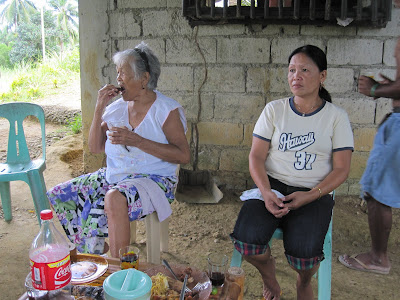
If you are a regular follower of this blog, you'll remember my recent Fiesta!!! Blog post. Well, come to find out, fiesta is not quite over. Currently, we are experiencing the post-fiesta period of 'Random Parties at a Smattering of Homes around the Relative Community.' That's right, my American tendency toward definite beginnings and endings got in the way again, and the town around me is happily continuing the fiesta tradition in perpetuity. This morning, I was minding my own business, writing on the computer and listening to some new music, enjoying Starbucks House Blend from the French press when all of a sudden, a disheveled old woman hobbled up the stairs speaking in a mix of Waray and Gibberish, declaring that patron was happening, and I would have to go with her. I reasoned with her, told her I was not ready, that I was sick (which was true,) that I had lots of work to do (which was not), but, alas, I gave in, shaved, threw on some clothes, shut down all of my electronics, and walked with the old lady to the Patron. In the 100-degree sun, weslowly walked down the little path through the grass, across the road, and to a house where I had never been before, the little lady holding fast to my elbow, slowing me down so as to get me as sweaty as possible before going to the mystery house to be the token white guy for the day. We got to the home and I met a bunch of new people and ate their food, in my normal style, sweatily sitting in the corner, with fan blowing in my face and gingerly chewing mystery meats, tirelessly searching for sharp bone fragments with my tongue.


After a few minutes, I looked around, searching for the little old lady who had drug me to this home, just to find out that she had abruptly left to go home, saying she didn't feel like eating lunch. Fifteen minutes later, I was still sitting in the little house, wondering when it would be okay to leave.


A neighbor, Totoy came then. Totoy has but one vice, and that is he is always drunk. He lives in a nipa hut nearby and somehow is related to the family whose house I was attending. Already drunk on coconut wine, Totoy sat down in a plastic chair in the middle of the little room and would randomly smile from time to time, squirming in his chair, pretending to dance, but too listless to do it while standing. Recognizing me from the waiting shed where he often sits in a drunken stupor while I wait for jeeps to take me to town, he shook my hand and nodded abruptly. For the next 20 minutes, while I sat, full on rice and other questionable foods, Totoy would look around, aimlessly smiling, and then fix his gaze upon me, pound his chest with a sideways fist and say "Friend! We-are-friend- Peter!" and then go back to looking around.


I finally just said I was full, thanks very much, and that I would be heading back to the house. The host said thank you also, and that before going home, I should stop by her sister's house on the way, who might also be preparing for my arrival. On the walk back home, I stopped at her sister's house, who hadn't prepared for me to come at all, and just gestured for me to sit with everyone outside where they were downing a 6 gallon jug of coconut wine, 1 gallon at a time. I sat down in the midst of the Tuba drinkers, 3 middle-aged women, 3 men, and an old lady. They awkwardly didn't know what to say to me, and motioned for me to drink tuba. Since I was on antibiotics, I gracefully declined their offer, and said I would just sit with them. Without much idea of what to say to me, the group began talking about Alan Jones, a Peace Corps volunteer who was the last volunteer to be here in the town before Selena and I. I asked when Alan Jones was here. The old lady, sloppily eating a chicken leg, bits of meat falling out onto her pajamas, looked up to the left, then up to the right, then screeched, "Ahh, mga 1940's maybe." I respectfully smiled, knowing that since the Peace Corps started in 1961, this old lady was a little off. One of the women then said, "Ahh, kwan,(um) 1970." And then one of the guys said that he remembered it being in 1982. I'll just have to google Alan Jones and see if anything comes up.

Taking things apart


From the earliest moments of childhood I can remember, I was taking all sorts of electronic things apart. My fascination with the entrails of telephones spurred from a sense that I had that if I paid close enough attention while taking something apart, I could surely put it back together again. I did this with an old adding machine, a typewriter, and several phones, that I can recall. I precociously figured that everything, when broken down to its basic ingredients, was pretty simple. A telephone was just a conglomeration of lots and lots of simple ideas all thrown together into a functioning instrument. A rocket just represented little basic epiphanies from lots and lots of people, coalesced into a big, heaven-bound man-carrying flare. This reasoning followed with a T.V., an adding machine, a car, really anything else. On a Saturday in the 90's, in Montezuma, Virginia, you could have probably found a curly haired little boy sitting outside on the flagstone patio, or a bushy haired pimple faced teenager, (my grandmother told me that hair was every 80-year-old woman's idea of the perfect permanent. You can't imagine the effect that has on a young boy growing up.) taking some complex electronic tool apart, foolishly expecting to be able to put it back together again. I don't remember taking apart a single thing that didn't have a catastrophic defect when I haphazardly put it back together. I didn't approach the projects like a steadfast Type A person, keeping track of screws and wires. Rather, my approach was more like that of a Type Whatever, scattering parts in a 5 meter radius feverishly aiming for the center of the instrument at hand, and then, with forlorn brow, sunken shoulders, vigilant eyes for parents, and sweaty upper lip, throwing everything back together based upon general shape, not functionality. My wife would probably agree that this is the way I generally approach life, without a whole lot of far-sighted planning for the future, but a tenacious grit for getting to the bottom of things, God forbid I achieve the objective. (As an aside, if you are a graduate admissions council member and have stumbled upon this blog during a google search of my name to see if I have any skeletons in the closet, please recognize the literary embellishment that I am employing.)


So anyways, one would hope that I would grow out of my proclivity towards taking apart rather complex electronic gadgets and leave that to the engineers who understand them. Well, to make a long story short, I have included a picture of a 399 Gigabite external hard drive that was not performing well. I heard a clicking and thought that I could help. It is now awaiting permanent disposal in the family burn pile.

Wednesday, May 18, 2011

Kuya Ronelo (Nic) Hidalgo


This week, I accompanied some other Peace Corps Volunteers and my friends from the local climbing club, Saypung Club, to Kan Apoy cave. I went to the cave last year as well, and enjoyed it a lot both times. It is a relatively short cave with some vertical dynamics that really make a rope crucial if you want to view all of the chambers. The biggest attraction of the cave is the fact that there are hundreds of thousands of bats everywhere, leaving lots of feces (gwano) which lends itself to an amazing ecosystem of millipedes, cockroaches, and all sorts of beetles who live in the stinky stuff.


Kuya Nic, as I like to call the leader of the group, is a head english teacher at the local high school, with lots of charisma and passion for teaching others about protecting important ecological niches like Kan Apoy. The club is in need of harnesses and ropes, along with financial assistance for transportation for ongoing trekking events in the area to keep the learning process alive, if anyone is willing to give. Thus far, I've been able to get tents from James Madison University and some name recognition for the club, and we've given a rope to the club, but they need good helmets, harnesses, sleeping mats, and other stuff for outdoor trekking. Although great for the members of the club, trekking clubs are also crucial for preservation of the environment of the Philippines and local treasures like cave Kan Apoy. The more foreigners and visitors show an interest in visiting places like this, the less likely it is that they will be exploited for their raw natural resources. If you're wondering if this is a plug for support, it is, but it's a well-deserved plug.

Rappelling like a Champ, PCV Kelly


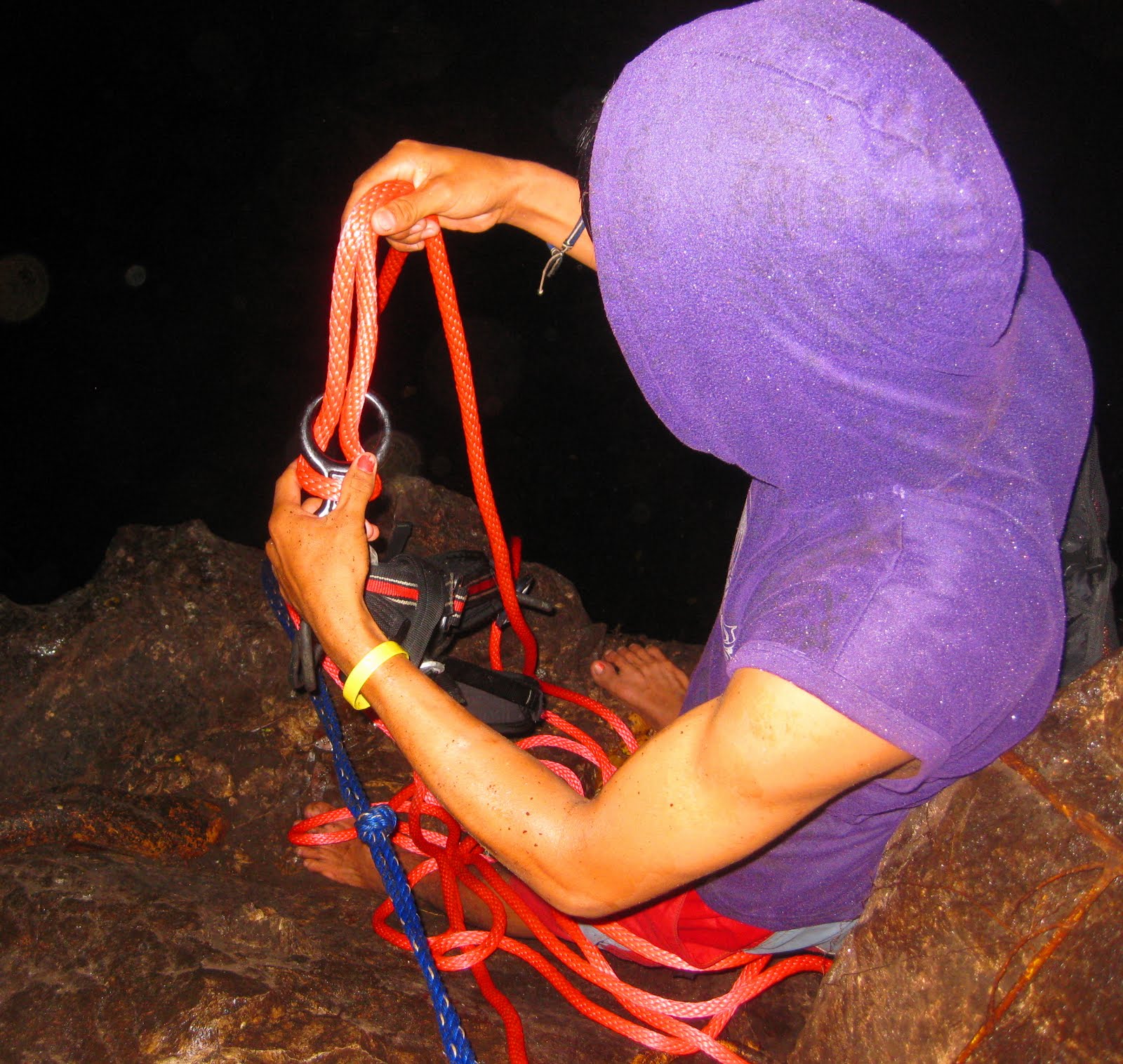
On the job training: The Filipinos who were along with us were eager to learn about rigging for rappelling. We all shared my one harness, carabiner and figure 8. It took a while, but was a safe descent.


At the bottom of the pit looking up at the rigging point. The rocks of the cave are unlike the flowstone patterns in limestone caves of Virginia and West Virginia. Vines fall some 80 feet from tall Mahogany trees outside the cave.


The labrynthe of vines and mossy stones at the main skylit hole makes for a great group shot.


The bats are primarily fruit bats, feeding on the plethora of fruits outside the cave at night and the associated flying insects. I would estimate that the wingspan of most of the bats is 15 or 16 inches.


Saturday, May 14, 2011

Fiesta!!

One of the Spanish traditions that is alive and well here in the Philippines is the fiesta celebration. Every municipality and barangay in the Philippines has their separate, special fiesta time, all of them devoted to a saint. The municipal fiestas are the biggest celebrations. In the Philippines nation, the size of New Mexico, there are 1400 different municipalities, and 40,000 barangays. That means a lot of fiestas. If you have family or good friends in a nearby barangay, it is incumbent upon you to attend. This begins to explain why work is not a high priority here. Many days, a coworker has come into the office and inquired about someone who was supposed to be at work for a meeting. The response is usually, "Oh, he is a fiesta for Barangay Rizal", or 'Lukay,' or 'Naga Asan' or any one of the other 21 barangays in this municipality. Upon hearing that someone is a fiesta, all responsibility is forgiven, and the person inquiring, usually a lady, says, "Ahh" with raised eyebrows and her high heels click the bare concrete floor as she swivels and leaves the room.


Whenever I mention going to fiesta, I am warned to be on the lookout for witches. 'Witches,' I am told, 'like to go to parties with lots of people. If they see a white person or someone they want to curse, they will do a 3-point shot, and throw poison from a long ways away into the dish being consumed.' These curses usually lead to stomach discomfort, diarrhea, and headaches, oddly enough, some of the same symptoms that occur with food poisoning. A lot of times, you get sick from fiesta food, but I think it's probably because some things are undercooked. But, instead of accusing the cook of underpreparing the food, witches are blamed for bacterial contamination here. It's a much more non-confrontational way to do things.


Fiesta is a time when everybody makes as much seafood, pork, rice, chicken, karabaw, and root crops as they possibly can, and then generously invite all of their friends, coworkers, politicians, and family over to gorge themselves. The idea is to pick the most decadent household to go to first, filling up on food of wealthy people, and then, after getting full as a tick, waddling over to another household for tuba (coconut wine) and sumsuman (snacks to eat with coconut wine.) During most Filipino events, birthdays, weddings, anniversaries, etc., barcadas, or little groups of men drinking wine and eating snacks will be found sitting out in front of homes, or in some back room of the house, talking away, shirts off, drinking gallon after gallon of coconut wine. Most town fiestas are during May, which is dry season, so there is little chance of festivities being hampered by bad weather. However, the month of May is also hot as the dickens. So, in my case, add to your mental picture of all the seafood, the beer and tuba set out in a tiny living room with nondescript furniture and 7 people sitting in an area meant for two, an 8th person, much larger than the rest, sitting in the corner awkwardly with beads of sweat on his forehead and a non-oscillating fan directed straight at his face for maximum effect. That person is me.

Thus far, I have been to 4 homes for fiesta, and it's only the first day. Tomorrow, I will be going to 3 other homes, (and probably stopping by a few more on my walk home from town.) Everyone celebrates fiesta in some way, either by hosting a big party with lots of food, or, if you're too poor, by just sitting around drinking. Last night, after going to a few houses to make an appearance and contribute to food insecurity, I was turning into the walkway that leads to our house out in rice fields. At the little waiting shed at the end of our lane, there were 5 boys, sitting in the dark, quietly sitting and looking at the clear starry sky, the north star visible on one horizon, the southern cross visible on the other. They had a 5 peso pack of orange drink mixed with a 50 peso bottle of vodka and water in a pitcher, and were passing around a shot glass. The guys ranged in age from 12 to 35, and motioned for me to sit down with them, share in their fiesta. I obliged, sat down on the edge of the concrete wall beside them, and shared in a couple rounds.


The difference between the big 'lavish' parties in town and that of my poorer neighbors outside of town was like night and day, and the class struggle in this tiny corner of the world struck me. These guys aren't interested in flying to another part of the world, seeing snow-capped mountains, or even in having computers or internet, they just want a piece of the pie in our simple town. When the little pitcher was finished, everyone sat in silence and looked out at the star-gemmed night's sky.