Saturday, August 27, 2011

100 Million People in New Mexico

If you were to take all of the 7000 islands of the Philippines and cram them together, the combined land area would resemble that of Kansas or New Mexico. It's not a big country. However, recent census figures estimate the population to be around 95 million people, give or take a few million due to all of the people squatting on government land and without birth records. Upon arriving here as a volunteer, I had two nagging questions concerning these figures.

1) How in the world do you cram that many people into that small of an area and expect them to be able to live?

2) If Filipinos can coexist with that sort of population density, then we have a lot of potential for growth in the states where the population density is much lower, right?

When sitting watching the fishermen earlier make raw fish with vinegar (Kinilaw) for lunch, and nodding off with the fresh monsoon winds that were whipping against the floating guardhouse, I decided that now, at this point in my service, I have answers for these two questions.

Question 1: Filipinos are very social and are able to be happy in the tightest of conditions (Refer to Post #51 What Really Matters.) Natural resources, although greatly denuded here, are utilized to their entirety. Every single animal that lives here is eaten. There aren't any taboo animals, well, except for puffer fish, I can't figure that one out. Snakes, rodents, dogs, water buffalo, pigs, monkeys, lizards, and salamanders are all eaten, along with birds, poultry, fish, sharks, rays, squid, seaweed and a lot of other stuff. I think of the fat, healthy looking herbivorous groundhogs at home that people shoot and just let lay due to some sort of choosy taboo we have about eating rodent-looking animals. When a ray is caught in the ocean in the states, it is often thrown back even if it is dead, because we're just really choosy. One time, early in service, the family Dog of a fellow volunteer's host family got Tetanus and died. Within a day, a neighbor had come and carried it away to cook for supper for his family. No joke. People here eat fish heads, pig face (Sisig), pig and poultry feet, barnacles, all sorts of filter-feeding shellfish. Whatever isn't eaten, is given to the livestock pigs, and then in turn, those pigs are also eaten when they are of roasting size. Small filter fish are eaten raw and dried. People just don't have qualms about it. Ofcourse there are problems of over-harvesting of timber and fish here, along with pollution and soil conservation, but those are education-related issues it seems. For the food though, there is just very little waste, nutrients all enter and exit the cycle over and over again and this sustains a population that is incredibly too high for the land area it occupies. There is a general lack of money here, and lots of malnutrition, (too much rice, lack of protein, stuff like that). This high resource use is very different, I feel, from the situation in the America where there is incredible waste of food resources. We're really really picky, and I didn't really see that until I came here. An old lady whom we lived with for a couple months at the beginning of our service here in Babatngon pulled me aside one evening, her ancient withered hand yanking at the sleeve of my shirt, and huge false teeth gleaming white "You know, us Filipinos always say that we would never go hungry if we moved to America. We would just eat all the fish heads that you people throw away."

Question 2: No, Americans don't have a culture that would support this level of population density. We like our space, our autonomy too much, and there would be an all-out war if we attempted to squeeze 100 milllion people into New Mexico. It just wouldn't work. Filipinos though, thrive on closeness, on what I call crammed quarters. That's why you can get 45 fairly happy people into a the back of a pickup truck here without so much as a complaint. At a Peace Corps conference, my counterpart was placed in a big, nice hotel room with only one other person and she nearly freaked out, said that there were spirits in the room, and vowed to never stay in such a large area nearly alone again. Similarly, the family of 8 downstairs prefers to all sleep together in one little room instead of spreading out throughout the house like they could. It's just a really different mentality here. Closeness is comforting, space makes for intense loneliness. Most people agree that the population density here in the Philippines is way too high, but it continues to work for the most part because, although unsustainable in terms of jobs or livelihood, the culture makes it possible.

Monday, August 22, 2011

Abstract: New Methodology for Eradication of Closet Room Dilemmas in Developing Nation, Barlow P.H. et. al.


In addition to leaving the heat, the aggravating rainstorms that get your clean laundry wet, the periodic blackouts, and sketchy public transportation, in about 8 weeks I'll be leaving a non-functional toilet behind that has plagued me for 2 years now. Indoor plumbing is less than dependable here in the Philippines, and about 80 percent of the public establishments still have toilets that you have to flush with a bucket of water, not with a handy little lever as we are accustomed to in the developed world. Whether you are in a hospital or a coffee shop, restrooms will have A) no toilet paper, B) a bucket of water and C) a big dipper to wash off your you-know-what when you get done with you-know-what.


Anyways, I would love to be blessed with that situation at home, but instead, we have a toilet that cannot even be flushed with a bucket. That's right, every single trip to the bathroom, you have to plunge everything away. I don't understand it, it's like they put a 1-inch pipe on the bottom of a toilet, like anything would go down that, and then, to top it off, they encased all of the pipes in concrete so that even if you wanted to fix something, there is little chance that you ever could. I'm serious, not embellishing this situation one single bit.


I broke the plunger about 5 months ago. Since then, not being able to plunge directly with the jagged broken plastic end of the apparatus, I have been using a wooden spoon over the top, to dissipate the force of the broken handle and make it easier to use, since I can never remember to just buy another plunger at the market, what with all the people looking at me and asking me, "Sir, do you want Bananas?" or "Sir, do you want fresh fish?" or, "Where are you going, Sir?" or "American!" or "Hey, Joe!" I usually find that no matter how long, the market experience has taken long enough, and I hurry back to Bag End where the hobbits hide away waiting for another adventure.


Moving on, I remembered to buy a plunger today. It's a locally made plunger, from tire rubber and with a wooden handle. It cost me 70 pesos, (I bargained it down from 75.) It's a good plunger. Now, instead of broad, decisive blows to the toilet bowl, I have been utilizing the rescue breathing ratio of 5 soft blows and then I step away for 3 seconds and listen for breathing. It's been working so far and I think that I might have a system now to last me for my final 8 weeks of dealing with my irritable toilet.


Friday, August 19, 2011

Fish!!

If you have followed this blog in the past, you will have seen several posts about the Integrated Aquaculture Project here that has occupied most of my working time for the past year or so. It's a project where we are growing seaweeds in concert with Bangus Fish, the Philippine national fish, to generate the livelihood for 35 families in the coastal area here as well as improve understanding and enforcement of local environmental protection laws for a marine protected area. Seaweeds filter water; they utilize nutrients like nitrogen and phosphorus to grow carrageenan, an important cash crop the world over. It's known in the environmental field as a bio filter, one of the things that yield a double return, cleaning the environment while producing a useful material. Carrageenan, as I've mentioned here before, is used in laboratory supplies, as well as jelly, Jell-O, toothpaste and many other vitally important products. We can sell seaweed at a local factory, where they pay a base price for the dried product, the profit which is then split up and given back to association members for working every day to clean and harvest the seaweeds. Thus far, the fishermen have made around 8000 pesos ($175) from the seaweed harvests and the stuff is still growing strong. The seaweed is a new idea to most of the members who consider themselves fishermen first and foremost, and farmers of this slippery, slimy stuff second. Despite their reservations, the men have gotten into the habit of going to the ocean every day and shaking algae and dirt off of the seaweed, trimming it, and drying the harvested pieces. At times it has been hard, keeping these men interested in a project with seaweed that they never really asked for. At the outset of this project, I promised the men that I would find them funding for a fishcage project, (something more of the cultural norm in these parts, a much more tangible project) if they would be willing to try growing seaweeds, a lower return, more environmentally-friendly crop. They obliged and ever since, we have been working the seaweeds, waiting with baited breath for the arrival of their hallowed fish, the 'real' livelihood project.


This past week, the project finally came together in its entirety. After lots of heated texts and rousing speeches about fortitude and project goals by the resident persistent American (me), the municipal dump truck showed up Wednesday with hundreds of bags filled with little fish fry from the local nursery. In all, we received 5000 little Bangus fingerlings and now the 35 fisherfolk association members are beneficiaries of a 'legitimate' livelihood project, raising fish. They are changed men, what can I say. There are certain cultural litmus tests that have to be passed for the members to feel real pride in this project, I've found. One test is the association boat. For two months we borrowed boats, used private boats, even paddled out to the seaweed project to work, but once we bought an association boat, members were changed. I found that here, to be a bonafide association, you have to have your own boat. That makes you legit. Period. I don't know how to explain it, but there is a palpable change in the men since we have gotten an association boat, it seems to give the group a common, tangible bond that they didn't have before. The fish cage is the same. The members would be willing to work on anything that brings profit, but when they are raising fish, a crop they know and others recognize, the project has a certain credibility that wasn't there before.

Earlier today, Selena and I went out to the project site with a Peace Corps supervisor, Philippine government workers, and association members and sat with association officers while they fed the squirming, writhing fish, and they were able to talk as authorities about their project, the feeds, how they are doing, the condition of the nets. If nothing else happens, if the project were to die tomorrow, the fish were to escape into the surrounding ocean, if seaweed were to suddenly die, I can be sure that the members of the fisherfolks organization have pride, and I did as much as I could to help them achieve their potential. As this experience winds down, and I pack to go home, taking what memories I can fit onto a hard drive and in my mind, leaving the children, dogs, neighbors and friends I have met, it is a sound consolation to know that I've done what I could to help.

What really matters?


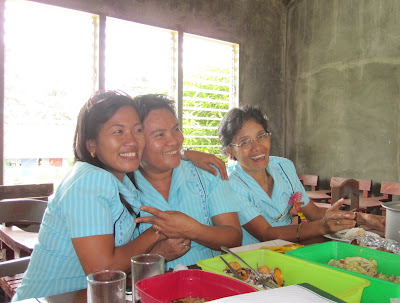
A good friend recently lent me the book "The Art of Happiness," a series of interviews and excerpts from speeches by the Dalai Lama. I haven't finished it yet, not even a half an inch through it, but something that I found meaningful for me in the first hundred pages was a very clear distinction that The Dalai Lama makes between pleasure and happiness. Pleasure, he articulates, comes from attainment of the perfect body, possessions, and soul mates of our dreams, the gratifying albeit fleeting satisfaction that we get them all. Happiness is the lasting satisfaction that comes from a cultivated compassion for every other human being, the satisfaction that comes from finding intimacy in every encounter, and every relationship we may find ourselves in. Intimacy of course, as is defined in the book, is whenever any two beings come into bodily contact, not our western view that intimacy must be an erotic encounter between lovers. While reading this explanation for the distinction between pleasure and happiness, I began to think about the wide chasm of difference between my native culture and the one that I have come to embrace here. Anyone who has the chance to spend a couple weeks living among Filipino people would most likely attest to the fact that people here, although living lives devoid of the 'pleasure' we have in America, are much 'happier' than persons in our corner of the world. Filipinos are much more tactile people, always touching your leg or rubbing your stomach or arm while they talk to you. Oftentimes, I'll be sitting with a group of middle-aged men, drinking tuba (coconut wine) and eating little bits of squid and raw fish, and one of the guys will turn to me and start talking about something or other, whether I understand him or not, and he'll put his hand on my thigh the whole time while he tells me some local joke or story, and laughs a hearty laugh. Now just think about what would happen if that kind of intimacy occurred in the states, if some guy at a bar put his hand on another guy's thigh while he joked with him and talked about a football game. It's been one of the weird things to get used to here, and although I've been uncomfortable at times, I see this affection, this tactile nature, as one of the things that makes these people so happy despite their need for so many material possessions that we take for granted. Of course it's not just their aptitude for touching each other's thighs that make Filipinos happy, but this is just one facet of the culture of unconditional affection, compassion, for each other, that I've come to appreciate. This culture of affection can be infuriating when you wish to hold people accountable for wrongdoing, when you wish to confront someone who has gone against the grain, stolen goods, not done their duty cleaning seaweed, stolen your precious tomatoes from Virginia, but at the same time, this nurturing, amiable culture creates a higher level of happiness among people. There are definitely many things that this culture could learn from ours, indoor plumbing, road right-of-way laws, traffic enforcement, basic sanitation, natural resource management, but I think many of these pale in comparison to what we stand to learn from the culture here: Happiness.

Saturday, July 16, 2011

Ang Kalikasan (Tag. Nature)


We have broken down most natural processes that used to be anomalies. Photosynthesis and other types of metabolism are understood, the cell has been parsed out to its many organelles, the human genome mapped, chemicals broken down, new ones created, crops engineered to withstand nature's wrath, we've taken long carbon chains from the bowels of earth and put them to use powering cars and lighting our homes, space shuttle launches have become commonplace, and our exploration of the solar system and deep oceans continues, breaking down every bit of life into their infintismal parts and on, and on, and on. In the midst of all this understanding, I wonder sometimes if we have become so myopic that we cannot see the mystery that still exists in every little detail and their synergistic conclusions. In and of themselves, the chloroplasts within leaves aren't that baffling, and neither is movement of air, or the chitin and nutrients that make up insects, but together, a mystery still exists when a Butterfly sets to fight against a breeze to perch on the leaf of a cottonwood. Just like us people, one man, his blood, bones, and skin, is just that, a man. But when you put people together, working, creating cultures and civilization in concert with other animals and plants, a mystery of synergy unfolds. I don't pretend to know who makes these things happen, if the being is Christian, Muslim, Buddhist, Panantheist, Hindu or a little bit of all of them, but I do know that just because I understand the inner workings of a blade of grass or flowing stream, I may never be able to understand the miracle of this creation. I'm okay with that.


Saturday, July 9, 2011

Construction


This is a short post, but something that I found really interesting this week. I was waiting for a meeting, an inspection really, where the Department of Labor and Employment would come out and review our progress on the fish cage project that they're funding. Well, seeing as how we haven't really done much on the fish cage yet, the 'inspection' turned into a halfhearted 10 minutes at the actual site, sitting at the new guard shack, and then 2 hours eating seafood and drinking coconut wine upon our return to town. That's about how 'important-people-visits' go here, not much substance, but way too much eating a drinking. This is something I lamented for 18 months of this experience, but have come to expect as a part of the culture, the way things get done.


Anyways, so I was waiting for the meeting, which, true to form would end up being 2 hours late, and came across this construction site where guys were hoisting cement up on top of the building that was going up, a bucket of liquid concrete at a time. They were using a bamboo system of ropes and pulleys to hoist it all up, and, for me coming from a construction background of boom lifts and skytracks, it was really interesting to get a feel for how things got done before all of our technology was available. I've added some pictures for explanation.

Old Habits

The fellows check out some United States fishing tackle my cousin Matt sent last year. They were amazed at the odd thing, kept turning it in their hands, talking about how it would swim through the water.


Birthday for Jimmy, (Right) He was 44 years old and we celebrated with Barracuda, huge shellfish, crab and coconut wine.


The crab we later ate for Mano Jimmy's Birthday


Shark the fishermen caught on thursday. It was really young, but tasted very good.


The lazy afternoon while we relaxed and then later would follow Mano Juin's lead and chase out illegal fishermen (read below)


The group of men that I’ve been working with here are like any other group of young and old men in a small rural community of the world, in that they have ingrained habits and are sometimes very opposed to changes in those habits, especially when those suggestions to change are coming from a young, ‘inexperienced’ volunteer from the United States. I liken these fellows to a group of bear hunters in the mountains of Western Virginia where I come from. Bear hunters are notoriously a rough lot, deeply entrenched in family and community cohorts, who stereotypically follow hunting laws loosely. They’re the guys you don’t want to cross when you’re too far from a forest road and they’re out running dogs. If you know what I’m talking about and have a hard time imagining the fellows I’m working with, just think ‘bear hunters’.
Anyways, these guys are fishermen, who have been taking what they want, when they want, where they want for years. They fish in waters that their fathers and grandfathers fished. They know where to get the huge Conke-like ‘Binga’ and they religiously know the deeper channels where one can hopefully net a blue marlin on good nights and small tuna on others. When these guys aren’t fishing, they’re either drinking coconut wine, sleeping one off, or painting epoxy on the hulls of boats that should have been retired years ago. This is what they do, what they know.
That’s why it is such a change of courses for them, for me to be asking men who only know fishing and only really want to fish, to be growing seaweed and learning to save and invest resources. To say the least, they don’t really cherish the change of schedule, and would rather be fishing from 7pm to 7am for fish they know are there, than sitting at a guardhouse overnight ‘protecting’ seaweeds, this strange new crop, for a harvest that might or might not happen, depending on the next typhoon that rolls through. I don’t think I have explained fully the leap of faith the project is for these men, who really don’t have much trust in any livelihood but the one they’ve grown up with.
The seaweed/fishcage site is beside the municipal fish sanctuary, an area off-limits to fishing and collection of shellfish. Mano Juin, one of the fishermen was collecting shellfish in the sanctuary one day as we prepared seaweeds, tying the little shoots to long nylon lines that would float through the water. I talked to him, surrounded by other members of the association who smirked at the idea of actually enforcing the sanctuary laws. In our town, nobody really monitors protected fishing areas, the mayor doesn’t seem to care, and it is really farse to try and uphold the laws, but, I continued with my shpiel about how these are Philippine laws, how they should care, how it’s about their children and their way of life, not mine. They just laughed it off, and I counted it as a loss and walked off in a huff.
Then last week, Mano Juin, along with another member of the organization were blatantly fishing with nets in the sanctuary as we were boating into clean seaweeds for the morning. I turned to the boatman I was with and angrily told him to steer us toward Mano Juin’s boat. We pulled up alongside, and I let out a diatribe about not respecting laws, how it is for everyone’s good that we have laws and regulations for fishing, ‘if they don’t change, who will?’ all that kind of bleeding heart, environmentalism sap. The boatman and I sat waiting while Juin took up his nets, not speaking, eyes averting my stare, I took pictures, threatened to give them to the mayor, (like that would do any good), and waited until he paddled his small boat home, out of the sanctuary, properly shamed for his indiscretion. The other members of the association just laughed about the encounter the next time we were working together, joking about ‘naughty Juin.’
It’s been that way every time we discuss fishing laws or why illegal fishing is wrong. It’s hard to get these guys to see it any other way, but I figure for the next three months, I’ll keep on trying, not really anything to lose.
Yesterday, all of the association members and I got together and had a work day. Together, we used old nets and knives to scrape barnacles off of the guardhouse drums. It was a good time, we ate papaya and chicken while sons of members fished with squid for little puffer fish and other fishes that inhabit the coral reefs below. At one point, as I sat with my back turned to the open water of the ocean, Don Don, president of the organization pointed out to the water and said ‘mga illegalista’ (illegals), shaking his head, and pitying chuckle. Everyone looked at me and asked in waray, “Will we go get them?”
Somewhat defeated at the issue, I just shrugged, “It’s up to you all. I’m not Filipino, why should I care? It’s your fish, your ocean, not mine.”
They all laughed, nodding, and looking out, hissing through their teeth, (Filipino nonverbal for ‘no good’) We continued to sit for a while, and then out of the corner of my eye I saw a small canoe skirting across the water, a man furiously paddling. Now, I have to explain, you don’t usually see Filipinos moving quickly unless there is imminent danger or if they’re playing basketball. Additionally, we had several motorized boats sitting idly by, why someone would be paddling so quickly when they didn’t need to was a quandary.
I then asked, “Who is that?”
“Ahh, Mano Juin will get them.”
I looked back around and he was about a third of the way to the illegal fishermen, around 250 yards away. It was quite an expanse of wavy water to be paddling across, but he didn’t let up, and continued paddling, unrelenting.
I then realized the gravity of what I was seeing. Mano Juin was making amends, showing me, without words, without apology, that now he understood. To a lot of these people, words mean nothing, smiles mean less, but sweat, and work, you can’t fake that. As sinewy Mano Juin paddled across the rolling water by himself, he showed me that he understood.
When the other men saw the gesture Mano Juin was making, they all decided to pile into the motorized boats and follow his lead. Our deputized members put on their Law Enforcement shirts and we went out into the water and chased the fishermen out of the waters, taking pictures as a warning that we had evidence were they to come back.
A couple of years ago, the scene wouldn’t have made much impact on me. Just a bunch of guys in a boat, trying to enforce laws. Now, however, I understand how hard it is for people here to enforce rules, single each other out and reprimand. A communal culture like this one makes it really difficult to be objective and enforce laws for people who are probably cousins, or drinking buddies, or classmates in school. I’m just a foreigner asking a bunch of older fellows to change their ways, their schedules, 40-year rituals. Usually I’m not very emotional, but as we all put-putted across the water in a unified effort to begin enforcing laws for everyone well-being, and Mano Juin continued paddling by himself, I was choked with gratitude.