Friday, September 23, 2011

The last return

I spent the beginning of the week in Manila for our close-of-service medical visit where we submit blood and gut samples one last time to find out what all critters we have crawling around inside, what new ailments we've managed to pick up in our travels, and spend some time with the rest of the volunteers from our initial batch who will also be leaving shortly. At the end of 3 last days saying goodbyes, getting checked out, finalizing logistics for the trip home, I flew back into Leyte one last time. Over the past couple years, I figure I've made the return trip from Manila to our Island in the Visayas about 20 times and I'm blown away at how my perspective on the place has changed. When initially flying into Leyte in August of 2009, the place was exciting, almost overwhelmingly so, with lots of taxi drivers at the airport gates, yelling for us to take their particular vehicle, the smell of Leyte Copra Oil in the air, sun beating down on our heads. We were so disoriented. This last trip was different, I've gotten to know the lay of the land, and when we begin our descent, I can now pick out the little roads and houses of Babatngon, my site, as we swoop into Leyte. I can see Punta Hill, at the tip of town, flanked by a tight cluster of nipas and concrete houses, and I can make out Kilangawan Island where I have worked with the fisherfolks to make the fish cage and seaweed culture. The little buoys are too small to pick out on the shiny water, but I have come to peer every time over the busy jet engines on our descent to see the tiny nipa roof of the guardhouse on the water. It seems so insignificant, so infinitesimal on the monstrous expanse of water, but at the same time, I'm proud to have something to show on that expanse, some sort of proof that somebody came, and sweated with the people to try and make something work, make their lives a little easier.


I liken the cultural divide between Manila and my site in Babatngon, Leyte to the cultural divide that you would see between Millboro, Virginia, and New York City, New York. (For those who haven't been to Millboro, it's basically in the middle of forest, at the convergence of a couple roads that most people don't take unless they live, hunt, or fish there.) So, given the cultural divide, you usually need to take a day or so at site upon return from business in Manila resting, not interacting too much with folks, easing back into the swing of things. I think most of the volunteers would agree that this is a pretty good attack plan for re-acclimating. However, Thursday, my first day back from the trip to the city, I was just sitting around, French press with sub-par coffee in one hand, water filter in the other, when Mana Bea came up from downstairs and told me that I would be eating lunch with her family today. I tried for some clarification on the event but didn't get very far, and got a rough idea of where I was supposed to go at 11:45. As instructed, I got cleaned up and rode my bike up to the venue at 11:45 as promised. When I got there, I saw a huge banner mounted on bamboo poles above a big spread of local food that said, "Happy 75th Birthday, Mana Ester." I paid respects to the birthday girl herself then, dressed in bright colors, friendly, with reddened face, proof she had already been sipping on the tuba, as she came out of the house, confused as to why I was at her house (the family failed to tell her that they had invited me.) She definitely hadn't expected me to come, especially since we don't really know each other at all, but covered well, and led me by the forearm over to a table and put a couple beers in front of me, told me to, basically, stay put. I looked around and found myself flanked on both sides, in front, and behind by a bunch of old women, the cohort you would expect at the birthday for a 75-year-old Filipino lady. I was very out of place. One of the few males at the event, her son who had come down to attend the event from Manila periodically came over to reprimand me for not drinking quickly enough, that the beers were getting warm. Well, I sat there for an hour or so, and finally Mana Bea, squealing children in tow, arrived. They acted surprised that I was already at the party, even though it was 1 pm at this point.


I ate the birthday food, went and skipped flattened coral stones across the glassy smooth ocean with kids, and then quietly got on my bike and slipped out, those warm sweaty beers still full, waiting for me to drink them.

Saturday, September 17, 2011

Be Like Water

This week, I've thought a lot about what this phrase means to me, and why I keep hearing it in various places, spoken by various people, for different reasons. Sometimes it is said with sage-like wisdom when hardships arise, sometimes in jest, sometimes merely in passing, but always with some meaning.

Water has the ability to create a devastating deluge or a feeble flowing finger, a mighty wall of power in the ocean or an elegant trickle at a mountain spring. To be like water is to always have direction, to react to situations and hardships accordingly, to glean silt or sand or leaves or debris from every billabong turn in the stream, but always having the ability to leave it behind, given time, lots of time. Water encounters obstacles, and either rises slowly, pooling to a crest to surmount or push that obstacle, or, when implacable, unmoving, water will always find a way around, flitting through cracks and crevices, filling every void with its satisfying coolness before moving on down the stream, clear of the obstacle. When boulders, or cobbles, or gravel doesn't comprise the streambed, water will seep, seep through the myriad of tiny tunnels between grains of sand, still traveling to its destination, always in the path of harmony, towards the freedom of a wide river, towards that immutable oneness of open waters, calm, and cleanliness. When, due to carelessness, water is polluted by someone passing, tossing garbage or soot, the stream will carry that burden, discolored, devoid of life for some time, but in the end, the entire stream will bear the burden of the waste, diluting the pain and carelessness until irrelevant and forgotten. If ever there is a rupture in a streambed, if dams are erected or rains pour too much to be satisfied by a winding channel, water cuts a new path, decisively straightening its course, the earthen streambed walls and grasses are uprooted with the strength of a bulldozer, plumes of topsoil and sediment cloud the clean riffles, but in the end, after time, the clay will settle, leaves filter out, grass will re-root, and a new streambed of bedrock and cobbles will form.

After thinking about these qualities of our lifeblood, I find the phrase more apt than ever. Just Be Like Water.

Thursday, September 15, 2011

Squeaky Wheels

The Peace Corps encourages volunteers to look objectively at their adopted communities, look for assets and deficits, figure out what's needed, and make it happen in one way or another. Whether or not we're experts and know exactly what we're doing, part of our mission is to look around and make whatever place we end up in, better, at least in terms of socioeconomic development. My wife, Selena, took a decrepit library at the local school, got new books, good books, found good people to work with, talked and talked and talked with them about seemingly basic ideas, and turned it around. I looked at a declining environmental situation around the coastal community, and got a grant for a sustainable aquaculture project to help and sustain a struggling marine fishery. We did cleanups and camps and training events to get communities galvanized as well. There are probably many other things that could have been done, and maybe our projects could have been implemented better, in more 'sustainable' ways. However, the point is, that Peace Corps encourages its volunteers to be constant observers, critical of community situations, looking for ways to improve, with or without the specific skills that are necessary to push the improvement through.

As my counterparts and I return home from this life-changing experience, I've been thinking about how this will translate into our lives in California or Alaska or Pennsylvania or Virginia or North Carolina communities. I think we're going to be really annoying. Okay, fair enough, I'll speak for myself. I'm going to be really annoying, trying to organize projects and cleanups and gatherings and the like. I've already got this idea to do a stream cleanup on Dry River, the river where I used to fish and pick raspberries and wade my feet on hot summer afternoons and almost drown during maiden launches of my poorly conceived raft ideas. I wonder why I never thought to do a cleanup before? Because the Peace Corps did it. It has made me this hyper community development person, and I don't necessarily think it's such a great thing. If I were on the Dayton, Virginia Town Council, I wouldn't look forward to me coming back and going to meetings with Perot-style diagrams of my river cleanup ideas, but I think that might just be in my future. Anyways, that's what I was thinking about today.

Wednesday, September 14, 2011

A look at this week


Association member Eo, with his daughter during an interview. He says he's proud of his family and to be a member of the organization. Eo makes his living fishing, earning about $30 a month for his family of 4. On a scale from 1 to 10 in terms of happiness, Eo says he's an 8, and wouldn't change anything.


View through the fence at the basketball courts in a neighboring village.


Me with counterpart Grace Calixte, Joy, Mana Abet and Ate Madel, the Fab 5 of the Agriculture office in Babatngon.


Donald and Jaci, friends and fellow volunteers in the neighboring island, Samar, on the eve of what would be a great adventure race, the 12-hour long Rurumba, orienteering and running through the jungle, a more explanatory blog forthcoming.


The Flush

For the past couple months, I've been having an ear problem. Off and on, for a couple days at a time, my ear just starts pounding, some sort of mystery liquid just floats around up there driving me crazy and won't come out, and I catch myself flexing my jaw in public, making Quasimodo face at people, head tilted and mouth wide, while I'm talking to them. I don't like going to the doctor, especially here, since I know that nosocomial infections are bad in the states, but in a Filipino hospital, one can only imagine the germs that you might pick up in one of those musty hallways with thousands of babies screaming. I just figure I should take my chances with what I have, instead of monkeying around with trying to fix what's wrong and possibly getting a disease of higher severity. That was the plan until my earache came back in full force this week, making me wince whenever a light breeze would find its way into my ear canal. Reluctantly, I walked out to the little concrete waiting shed to standby for the next passing jeep. Fifteen minutes later, I boarded. An hour and a half and 50 pages of my latest book later, I was downtown Tacloban at the receptionist's desk asking for an appointment. It was a Tuesday, so I figured it wouldn't be a tall order. I got my number, gave them my phone number to ring me when ready, and waited 3 ½ hours for the appointment when I was called by the little receptionist. I hurried back to their office and gingerly set down in an examination chair while the doctor began by telling me how small my ear canal is, how all Americans seem to have really small ear canals. I didn't even try for logic.

The doctor then proceeded to mix up some fluids and then shoot them with a syringe into my ear. Now I've come to find out that ear flushing is a common practice for a lot of people, that it's almost routine for some. However, for me, this was a new experience and I found the soothing sensation of warm sterile cleansing fluids in my ears to be almost erotic. After 2 or 3 rinses, the doctor exclaimed, and grabbed forceps and after a painful tug, pulled out a relatively huge ball of pus and ear fungus that had been accumulating for some time. Now an ear nose and throat doctor sees a whole bunch of gross stuff, but this dime sized ball of crap really surprised her, probably helped to remind her of the little joys that got her into the business in the first place. Immediately following the flush, I was able to hear things that I haven't heard out of my left ear in some time. The doctor said I have a bacterial and fungal infection, that the fungal roots are pretty deep, and I can't swim for the next couple months, (at least I can't submerge my headJ). I now have this daily wash that I mix up and shoot up into my ear with a syringe. I should have noticed that it had gotten that bad, but I guess we just get used to mediocrity and mild discomfort when it does not present an overt encumbrance to our daily lives.

Now I was thinking that at this point, I could take this post in a number of directions, I could relate the ear problem to the current political situation and how we need to just realize the problem, make hard choices and go to a flat tax with a new deal sort of thing, talk about the need to push against becoming satisfied with sub-par, but I think that would be taking my ball of earwax and pus a little far. I'm just going to suggest that if anyone gets the chance this week to get your ears flushed, just make the trip, set the appointment, and get it done. You'll be glad you did, I guarantee it. Seriously, take off work, or school, use a sick day, or just play hookie, and go pay somebody to clean out your ears, and let me know how it goes.

Monday, September 12, 2011

Flag Ceremony, Babatngon

As things here in the Philippines draw to a close, I am increasingly cognizant of the little things that have become commonplace that I should probably try and explain while they're still fresh. One of those things is the flag ceremony. A weekly, even daily activity that is practiced by each and every one of the 1400 municipalities here in the Philippines. Now some municipalities practice the event every workday, with passion and vigor, and sing a special song just for the municipality, and they talk about logistics like when people will get paid, if there's enough water, emergency situations, stuff like that. But this is Babatngon, and we do things a little differently here.

At the little municipal complex of Babatngon, a one-story columned building no longer than 75 meters, whichever local government employees who decide to come to work stand around in little clique-like clumps on Monday mornings between 7:45 and 8:00. Women all stand around talking in hushed whispers about the latest gossip, while men stand in other clumps of 4 or 5, smoking Fortune cigarettes and jovially laughing in unison at usually lurid stories of passionate encounters. As 8:00 a.m. draws near, some of the more responsible gossiping women start to steal glances towards the area of the flagpole but don't dare move and initiate the arduous process of walking 50 meters and standing in place for the 10-minute event.

At about 8:05, usually there are a couple of cops who walk by in their finest carrying a big stick with which they wrap on the big flag pole to get everyone to come out from hiding. They clang the flag pole for 30 seconds and then the sloth contest to get into single file lines facing the flag begins. This takes about another minute or 2, and then, once in line, women giggle as they clump up in the shady grass area because the sun is beating down on the concrete area where they're supposed to stand. At this point, there's always a couple women who go and talk to the others, and tell them to stand evenly in the lines on the concrete, and yes, they know the sun is there, and yes, they know it's hot, and yes, they explain the ceremony won't take long.

Once the policemen have stopped clanging, and the ladies are standing in line, and the men have stamped out their cheap cigarettes, we all stand quietly in line, looking forward at the flaking paint of the little municipal hall, the barred windows of the offices, and the Philippine flag waving, when a deafening sound comes from 2 huge speakers stolen from a Pearl Jam concert and they begin blaring out the national anthem. Now these speakers are a new development, and we used to all just sing in unison, acapella, and mumble half-heartedly through the song, but now, with the speakers, there is no need to sing, since you can't hear yourself anyways. After the national anthem is over, there is usually a short announcement from some lady I still can't remember the name of, when she lets us know why the Mayor isn't there again, and then the crowd disperses, the only sounds to be heard are wooden heels clicking the concrete parking lot and the lonely scratching voltage of the sub-woofers over at the municipal hall doors.

Although maddening, I'll miss the dysfunctional idiosyncrasies of our brief weekly flag ceremony, here in Babatngon, Leyte, Philippines.

Thursday, September 1, 2011

One Man’s Trash…

Playing a little ball with the neighbors


Last week, I got a wild hair to start the process of cleaning the place up to prepare for my departure from here in 45 days or so. My family would attest to the fact that I'm not a very tidy person, so whenever I feel the initiative to clean, I figure I better run with it and make hay while the sun shines. The first and easiest part of the process of taking the place apart to get it ready for my absence is to start taking stuff off the walls. I've mentioned before that my mother is both a gifted an a prolific photographer, and during the course of the past 2 years, Selena and I have taken all of the pictures of home we've been sent and taped them all together in big collages all over the walls. It's really nice to see those familiar sites from home all over the walls whenever we're sitting around, the green green grass of home, you might say.


Unfortunately, a lot of the pictures have faded as a result of all the sun and humid Filipino air in our house. I took down the collages, one by one, and kept the best of the pictures, the least faded, and reluctantly trashed the rest. After dealing with the collages, I went through a couple stacks of papers, teaching notes from the Filipino Science class I taught, little notes from students, papers from the Municcipal Office, letters to various politicians here, notes from meetings from the fisherfolks, flash cards for language learning, receipts for coffee and rolls, snorkels, nylon and buoys, a pretty good paper anthology of my work here over the past couple years. I threw most of it away, charging my memory to retain most of those activities since it doesn't make much sense to pack pounds of little papers out all the way back to Virginia. It's always hard for me to get rid of that kind of stuff, although I'd probably never look at it again, it's nice to know it's all there just in case. After going through the papers, my itch to clean was all used up, and I went out to play basketball and swim at the waterfall.

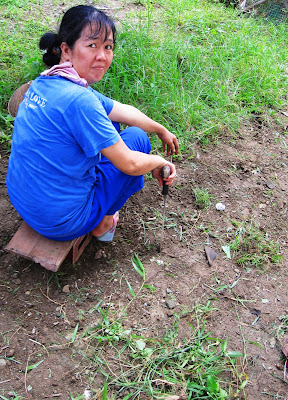
Mana Bea, the mother of our host family, doesn't take kindly to her picture being taken.


Later in the evening, I came back to the house, and saw the mother of the family downstairs with those collages in her hands, the faded pictures of family and familiar places. The sound of the door clapping behind me startled her and she looked over at me from the collage that she was holding up in front of her like a newspaper. "Why you throw these?! We need remembrances."


It is always irritating when she gets something out of our trash, but she was earnest in wanting to keep all of those faded pictures so that they would have something to remember us by. It's not really even us though. She was keeping pictures of my uncles and aunts, cousins and friends whom she will never know, all faded, and pictures of trees and flowers that didn't have anything to do with us. It was more like she was keeping the proof that people had lived and laughed with them, people from a distant place, people who looked different and talked different. In my haste to wrap things up here, I sometimes forget the cultural divide that we have bridged and the importance of a foreign presence to people who don't have much else to be excited about. I'd like to think that we'll be missed for us, for what we have done, but more likely, I think we'll be missed for the sense of specialness that our presence gave to others here, the pride of their town being picked to have people come and live for a while, leaving nothing but footprints, taking nothing but memories.

This is Mano Ted, the family father and little Nobi, the youngest of their 6 kids, helping to fill flower pots.

Late that evening, the trash fire consumed all of those little notes, receipts for rolls and snorkels, letters to politicians, flames molded them all back into ashen newness. And lots and lots of faded pictures went into a cardboard box, evidence of these two years.


This old fellow reads incessantly at the little waiting shed at the end of our lane, and silently watches the days come and go, shoes repeatedly repaired, and beard bound with rubber band. I really like him and his satisfied way of being. Just being.