Over the course of my Peace Corps experience, I've experienced lots of emotions, usually ranging from mild disapprobation to outright disgust with the way things are here. The mountains, streams, reefs and fishes are incredible, more colors and shapes and sizes of marine animals than I would have ever thought possible, but when it comes to the human element, it's been rough. I can't stand the way everybody just waits around all the time, waiting for things to happen. People stand for hours complaining about their lack of food or money while standing beside a fertile field with seeds in their hands. I can't trust anyone. My 'coworkers', the various gregarious nefarious politicians, the children who ask for pesos on the corners with bread in one hand and a begging bowl in the other, all of them, I feel, are subject to question when it comes to honesty. Even the local priest took grant money I solicited and earmarked for a waste disposal center and, instead, put a new roof on the church, among other things. It drives me crazy.
One of the biggest lessons I've learned here though, is that the lying, the indolence, the corruption, the lack of planning or any real foresight are not adjectives for these people. These traits do not describe the Filipino people, or the Leyte people, or even the local Waray people, but are symptoms of poverty. If you ask me, the Philippines is not what you see on T.V. Ten percent of the nation makes the decisions for the rest. Manila and the areas around it are doled out most of the money in the nation, whereas the rural areas just wait for the slush funds and NGOs to send in a trickle of funds, usually based in areas where politicians or their families reside. There is no national minimum wage, but different minimum wages throughout the 13 regions of the country, the highest of course, in the Capital Region of Manila, Quezon City. In Manila, the minimum wage is just over 400 pesos ($ 9) a day. In region 8, the place where I am, the minimum wage is 238 pesos ($5) a day, the lowest in the nation, and hasn't changed for over 10 years now. (keep in mind that money drives enforcement of laws, so there is little to no enforcement of the minimum wage in poor areas.) Most people who work at Local Government Units like the one where I am are political appointees, who don't get paid the minimum wage. These people are friends or relatives of politicians who ask for work as a favor, and usually don't have the minimum qualification for full-time employment, so are 'casual.' There are also 'job order' employees. They do all the grunt work, and get paid usually out of what seems to me to be some sort of petty cash system, and all of the details depend upon the local Mayor. The level of illegitimacy with which things are run is totally up to the locals. If there is any oversight for management at a regional or national level, I have yet to hear about it.
In America, we had the fortune to have our nation formed by statesmen who based our founding society on the highest principles of democracy, personal freedom and capitalism and ever since that founding, we've had hurdles, inequality, and poverty, but for the most part, our national focus on these founding beliefs has remained our collective ambition. Like it or not, the United States, with the near annihilation of the Native American people, started with a clean slate. Just the founding people, those ambitious founders who took the initiative to get on boats and come to a new, 'uninhabited' place, and make a new future, made up this new nation. A totally simplistic version of things, but it serves to sufficiently illustrate my point.
The Philippines societies, in comparison, were made up of many tribes throughout the archipelago, with chieftains, independent belief systems, sustaining natural resources, and a set way of doing things. Then one day Ferdinand Magellan and his cronies came along, and established the Philippines as a Spanish territory, immediately ushering all of the inhabitants of the new land into the catholic fold. Over the centuries since, the Philippines' existing cultures and traditions were beaten out of them in most of the areas. Some traditions remain, and the primitive language of 'Alibata' is being studied in the University of the Philippines in Manila, but that's pretty much it. Over the centuries of Spanish rule, 'Mestizo' blood was bred into the population, and most of the present-day dynasty families can trace their lineage back to early Spaniards with huge land ownership, or to Chinese merchants who settled here long ago. All of the big Filipino corporations, the malls, airlines, manufacturing centers, and most of the land, is owned by these powerful families. That's why many will agree that this is a superficially democratic nation with deeply entrenched oligarchical values. After the Spaniards came, the United States tried their hand at controlling the people of the Philippines and getting them to imbibe all of our values. Then the Japanese had a notoriously mercilous few years here, and then the United States came back, and finally gave a superficial ownership of this Filipino nation to actual Filipinos. We (the United States) supported a greedy despot for twenty years through marshal law and highway robbery, and in the 25 years since Marcos' departure, the country has continued on a rocky path towards modernism.
The people here are either rich or poor, with few in between. Either you're connected to a politician or you're not. Either you're getting lots of kick backs, you're on the take, or you're not. For those who are connected, the sky is the limit. If rich or powerful or both, you can go to the good schools, talk to the right people, go to the right parties, and really go pretty far. If you're not however, you really don't have a chance. The divide here is similar to that in the states between very rich and very poor. Just think social structure in the United States, minus our huge middle class. Take out everybody between the 10th and the 90th percentile on the tax bracket and you'd probably be close to the situation here. In this situation, the harsh sting of reality quickly quells any inclination of upward mobility. Squashes hope like my sweaty palm on a dim-witted mosquito.
That means that the people that I'm working with, the fishermen at the very bottom of the ladder, are not well off. However, they're accustomed to the idea that nothing is going to change. From their perspective, they have a social status that is endowed, and god forbid they challenge the status quo. From an American perspective, they have lost their spirit. I have seen students here, high schoolers with hope in their eyes and questions on their minds, but a lot of the guys I see, they don't have any of that. By teaching the kids here, I've seen that everyone believes at some point in their life that they can do whatever they want, and at some point, most people lose that belief. Part of my job, I feel, has been to try and restore some of that hope. It's been really neat meeting with the fisherfolks and getting them to talk through what they would do with a thousand or five thousand dollars if they had it. Their responses have gone from outright laughter, to confusion, to introspection, and finally, these last couple weeks, to real excitement. I went to Manila a couple months ago, and, without a whole lot of discussion with the fisherfolks, filled out a grant application for a project. I figured if we got the money and they didn't look like they'd be able to handle it, I'd give the money back. When I got back to Babagnon a week later, having submitted the application, I met with the fisherfolks about it. I told them the plan, and what we would be doing. Some of the fisherfolks feined interest, but for the most part, they were confused, and scared to consider the added responsibility of a project. Some of the officers even showed up an hour late to a meeting, drunk as skunks. I was crushed.
I decided to meet one last time before I cancelled the grant, just to see who all would want to participate, and how they felt. About 8 of the 30 fisherfolks showed up, along with their wives. We talked about the livelihood project, (growing seaweed for profit) and for the first time, I noticed some actual interest in some of them. Of course a couple people still were scared of the idea, but the mild support led me to leave the project as-is until we got approved or rejected, and I'd run it by all of the members again. Maybe the tangible idea of money would hook them.
An email showed up in my inbox last month saying that our project had been approved, and that funds would be released this May 16. I immediately scheduled a meeting with the fisherfolks. When we were all there, I told them that funds had been approved for the project and that we could begin setting up the seaweed operation at the end of May. As expected, the group got excited at the mention of money, but more than that, I noticed members who hadn't spoken at any of the other meetings talking excitedly about where they wanted to have the seaweed operation, how we would dry it for market in the city, what kind of nylon we would need, and how many sacks for rocks to anchor the big floating lines of seaweed to the ocean floor. We began talking about division of labor, who would buy the supplies, and who would guard the seaweed during the nights, and the men all raised their hands to be included in the activities.
Since that meeting, we have come close to the conclusion of nearly 7 months haggling with the provincial government to get additional government funds for a fish cage in the adjacent area. The proposed project would quadruple the monetary value of the initial Peace Corps-funded project and restore the fisherfolks' faith in a government agency that they don't see a lot of. This past Friday, a team of provincial inspectors came to the ocean to make a site validation for the project, and hopefully those funds will be released shortly. The project will total around $14,000, a pretty small contract by American standards, but a number that could really make a big difference to these 30 fishermen and their families.
Through this process, I've seen that all that lost spirit and hope can be brought back, but it takes time. I've worked for a year with these fisherfolks, and they're just now getting to a place where they are really excited to be working on a project together, something new, something that challenges their status that they had come to believe could never change, should never be challenged. Guys who laughed at the idea of a joint aquaculture project just 8 months ago won't shut up about how they want to build the guard shack and tie the bamboo poles for the project. Indolence transforms into excitement. Hope supplants cynicism.

 Kuya Ronelo (Nic) Hidalgo

 Rappelling like a Champ, PCV Kelly
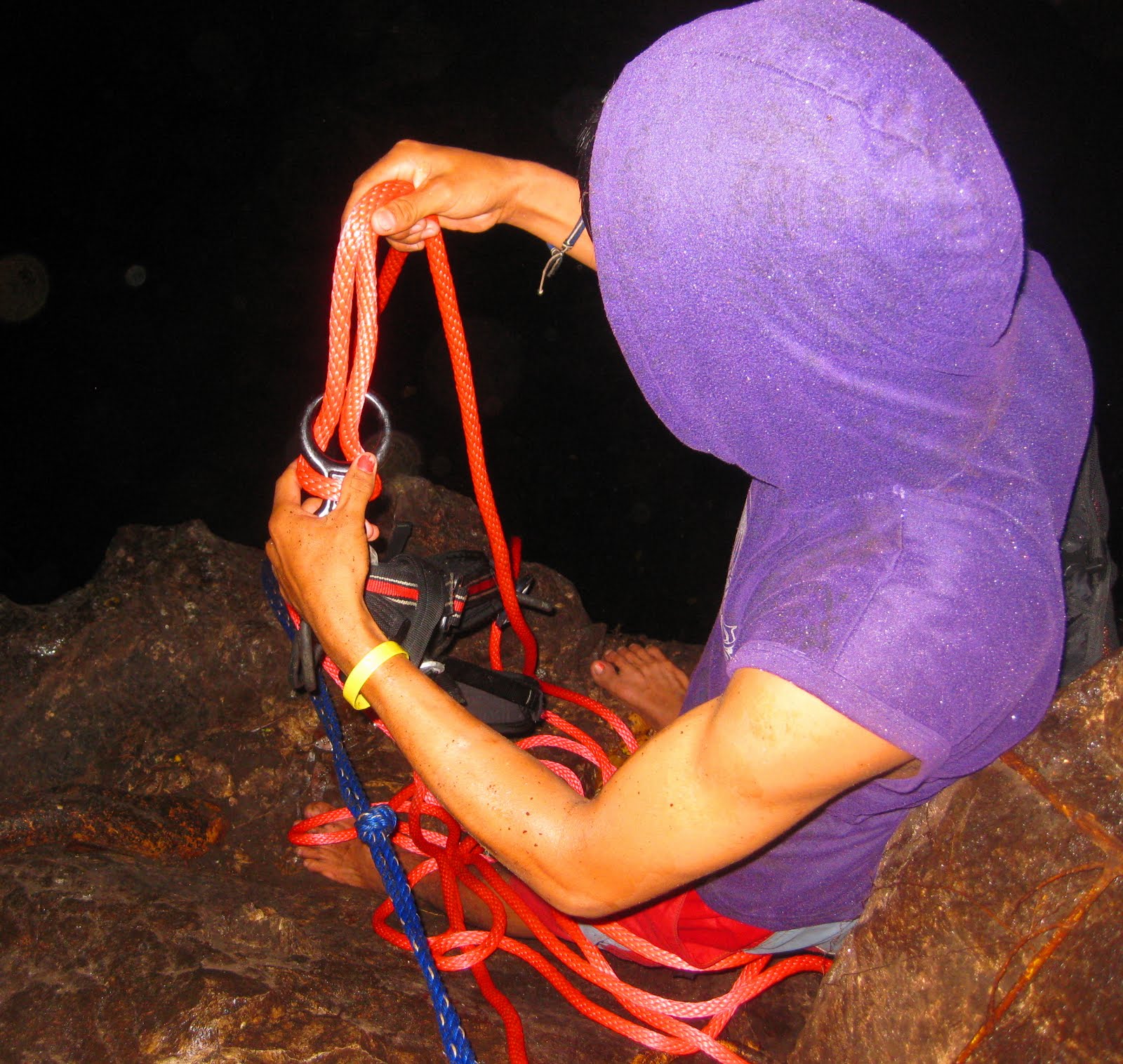 On the job training: The Filipinos who were along with us were eager to learn about rigging for rappelling. We all shared my one harness, carabiner and figure 8. It took a while, but was a safe descent.
 At the bottom of the pit looking up at the rigging point. The rocks of the cave are unlike the flowstone patterns in limestone caves of Virginia and West Virginia. Vines fall some 80 feet from tall Mahogany trees outside the cave.
 The labrynthe of vines and mossy stones at the main skylit hole makes for a great group shot.
 The bats are primarily fruit bats, feeding on the plethora of fruits outside the cave at night and the associated flying insects. I would estimate that the wingspan of most of the bats is 15 or 16 inches.


 , the size of New Mexico, there are 1400 different municipalities, and 40,000 barangays. That means a lot of fiestas. If you have family or good friends in a nearby barangay, it is incumbent upon you to attend. This begins to explain why work is not a high priority here. Many days, a coworker has come into the office and inquired about someone who was supposed to be at work for a meeting. The response is usually, "Oh, he is a fiesta for Barangay Rizal", or 'Lukay,' or 'Naga Asan' or any one of the other 21 barangays in this municipality.
  Upon hearing that someone is a fiesta, all responsibility is forgiven, and the person inquiring, usually a lady, says, "Ahh" with raised eyebrows and her high heels click the bare concrete floor as she swivels and leaves the room.
 'Witches,' I am told, 'like to go to parties with lots of people. If they see a white person or someone they want to curse, they will do a 3-point shot, and throw poison from a long ways away into the dish being consumed.' These curses usually lead to stomach discomfort, diarrhea, and headaches, oddly enough, some of the same symptoms that occur with food poisoning. A lot of times, you get sick from fiesta food, but I think it's probably because some things are undercooked. But, instead of accusing the cook of underpreparing the food, witches are blamed for bacterial contamination here. It's a much more non-confrontational way to do things.
 Thus far, I have been to 4 homes for fiesta, and it's only the first day. Tomorrow, I will be going to 3 other homes, (and probably stopping by a few more on my walk home from town.) Everyone celebrates fiesta in some way, either by hosting a big party with lots of food, or, if you're too poor, by just sitting around drinking. Last night, after going to a few houses to make an appearance and contribute to food insecurity, I was turning into the walkway that leads to our house out in rice fields. At the little waiting shed at the end of our lane, there were 5 boys, sitting in the dark, quietly sitting and looking at the clear starry sky, the north star visible on one horizon, the southern cross visible on the other. They had a 5 peso pack of orange drink mixed with a 50 peso bottle of vodka and water in a pitcher, and were passing around a shot glass. The guys ranged in age from 12 to 35, and motioned for me to sit down with them, share in their fiesta. I obliged, sat down on the edge of the concrete wall beside them, and shared in a couple rounds.


 In the early '90s, GPS technology, something used in the U.S. military, was opened up for public use, and has since become a huge part of mapping and using remote sensing to manage large spatial areas. In the United States, we have lots of data on everything now, from forest cover types mapped with GPS units, to city blocks delineated with underground infrastructure and specific addresses of houses, to school groups using the technology for Geocaching for scavenger hunts. Every year or so, new satellite imagery becomes available for every inch of the united states. We update topographic maps often, for higher resolution, or to depict land use changes, or to include information with higher precision. It is insane how much data is out there for use in GIS and spatial planning in the United States.


